Sunday, 13 September 2020

Ernest Duku in Le Monde Afrique

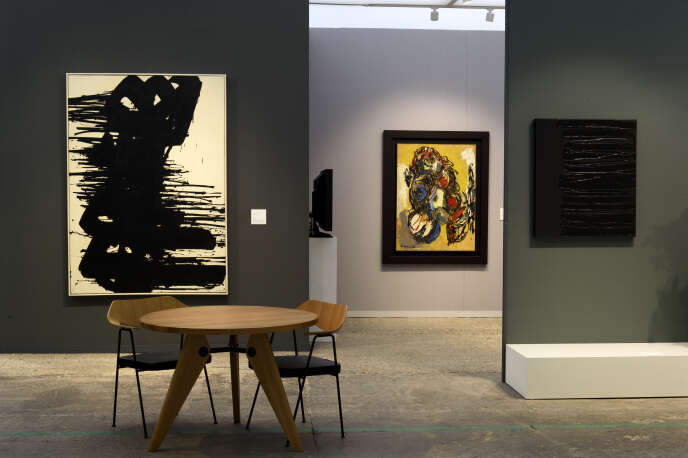
Dans la foire d’art moderne et contemporain Art Paris, au Grand-Palais.

Original in French | Le Monde Afrique

Ivory Coast: in Abidjan, the world of contemporary art is booming The network of galleries and foundations expands each year in the Ivorian economic capital, such as the very young Galerie Véronique Rieffel, represented at the Art Paris fair.


Even behind her mask, Gazelle Guirandou has trouble hiding her excitement. Thursday, September 10, the gallery she runs with Simone Guirandou N’Diaye, her mother, a renowned Ivorian personality in the art world, hosted her first exhibition since March and the outbreak of the coronavirus in Côte d'Ivoire.
“Last year, around the same time, we had already organized six exhibitions. We will finally be able to pick up where we left off and rediscover contact with the works, the public, artists… and collectors ”, rejoices the gallery owner in front of Ernest Dükü, the famous Ivorian plastic artist who will present on the occasion of the opening of some of his last pieces.
 
Read also "The real market for contemporary African art is in the West"
In recent years, the Ivory Coast has been showing its nose on the world stage of contemporary art. The latest example to confirm this trend: the participation of the very young nomadic gallery Véronique Rieffel in the Parisian fair Art Paris, a major cultural meeting for art lovers which took place from Thursday 10 to Sunday 13 September. Something to feel "invested in a fairly important role," says the curator who lives in Abidjan.
 
Véronique Rieffel moved to the Ivorian economic capital less than a year ago. A period of time nevertheless sufficient to make a place and a name in the bubbling Ivorian landscape of the visual arts. "I was drawn to the dynamic I found there, fabulous artists and some galleries with international projection. Seeing all this, I decided to launch myself in September 2019 ”, explains this specialist in the arts of Africa and the Middle East who, by the end of the year, will open a real physical space on the banks of the sea ​​in the nearby town of Grand-Bassam.

Multiple Galleries

This place will complete the network of galleries and foundations that stretches each year along the edge of the Ebrié lagoon. In March, the country's first contemporary art museum opened in the popular commune of Abobo, north of Abidjan. It was financed and built by Adama Toungara, a public official who is also one of the country's largest private collectors.

While contemporary art showcases are multiplying in Abidjan - there are now around ten - the local market is also developing. In the absence of reports or quantified studies, all professionals in the field interpret the slightest signals as confirmation of a growing market. "The occasional or permanent return of Ivorian artists is a sure sign," says Mimi Errol, artistic director of the Houkamy Guyzagn gallery and one of the only art critics and curator in the country.

Read also Important sale of contemporary African art in Paris 

The critic cites Ouattara Watts as an example, the prodigal son who left to live in the United States some thirty years ago and returned in 2018 for an exhibition. His compatriots, the sculptor Jems Robert Koko Bi and the visual artist Ernest Dükü, have also initiated returns, confirming the existence of market outlets for their productions.

In fact, during the 2018 exhibition, Ouattara Watts's works sold well, at prices ranging from 40,000 to 120,000 euros depending on the piece. "Some of her works were acquired by local collectors", confides Cécile Fakhoury, who hosted the exhibition in her gallery opened in 2012. Accustomed to major international art meetings, the young French gallery owner, who represents many numerous Ivorian and West African artists, has a second gallery in Dakar and a showroom in Paris. The first years, 90% of its turnover was made abroad but, today, she specifies, "without being at 50/50, there is an important rebalancing which took place" . And if there is no boom, "the upward trend in the local market is evident."

While the market is growing, its dynamism remains to be confirmed over time. To increase its notoriety, should an international event be organized in Abidjan? "Too early, the market is not yet mature enough," says a collector accustomed to great artistic raids. And a biennial? "The one in Dakar is very good and does the job," he adds, a little jaded. Other industry professionals, more enterprising and enthusiastic, are nevertheless planning an international auction in the coming months.

For Mimi Errol, a fine connoisseur of the field, “for ten years, the market has grown organically, gradually and resiliently despite political and health crises”. Better, Abidjan manages to "bring back its artists, to keep the youngest and to attract those from the sub-region", rejoices the art critic behind his desk. "But we have to move slowly, otherwise there is a great risk of seeing young artists giving in to the sirens of the market to the detriment of the creativity that is the soul of Abidjan," he adds.


Yassin Ciyow (Abidjan) ~ Superbe, Merci Beaucoup.

Thursday, 10 September 2020

Sam Kassan | Voodoo Artist from Togo


Artist: Sambiani Kassan

Date of Birth: 9th May 1961

Country: The Republic of Togo

City: Lome

Contact: +228 9025 7439


Sanctuaire de l afrique ou memoire d un u continent | Sambiani Kassan


Space for a description on materials used, size and technique.


Paintings

Description needed.


Compound of Wisemen, 1917 | Sambiani Kassan


Sculptures


Description Needed


Azuka Nnabuogor | The Biafran Artist


Artist: Azuka Nnabuogor

Born: 25th February 1973

Born in Enugu | Biafra, now known as Eastern Nigeria.

Lives and works in Lagos. 

Intro to be sorted at the weekend.......


Here are some of his works:


Title: Opinion Leader 

Material: Acrylic on canvas

Size: 30x30 inches
 
Date: 2019


Title: Paramount Ruler

Material: Ankara Fabric, acrylic on textured canvas

Size: 30x30 inches
 
Date: 2019


Title: IKENGA

Material: Ankara Fabric, acrylic on textured canvas

Size: 60x55 inches
 
Date: 2019


Wednesday, 9 September 2020

SANDRA-SANDRA | PERFORMANCE ARTIST


Sandra Sandra (Dohsane)

Performance Artist

Lives and Works in Cameroon. Yaoundé, Cameroon

Raised in | Libreville, Gabon

DOB: September 10, 1994

Contact: +237 6 96 91 60 58


Sandra-Sandra is an artist passionate about people but specifically around issues concerning women; also she has a great interest in the environment. She is a active humanitarian with her goal to use her art to overcome the suffering of others. This leads to one question ~ IF WE ARE ONLY HUMAN; WHAT DOES THE ENVIRONMENT REPRESENT TO US ALL?

It is the very nature that surrounds us? We, as humans, are toddlers to creation, newbies if you like, but our behaviour towards the natural world has been abominable. The essence of her work is based on THE OTHER, the decent humans and their environment; in her work she wants to speak up for those that care, the majority effected by climate change and be the mouth of those who have no voice. Sandra-Sandra is disinterested in being an Activist but more a participant in the expression of willing the world into an age of environmental improvements.

As a Performing Artist her new works focus on the Human. All that breathes and enters the cycle of existence. Clearly, we can see thematic diversity with social feminism, pollution and a human renaissance. Her works oscillate between literature, body expression and African Spirituality. 

-------
 
Sandra-Sandra est une artiste passionnée par les gens en général et plus particulièrement par les questions concernant les femmes; aussi elle a un grand intérêt pour l'environnement. Elle est une humanitaire active avec son objectif d'utiliser son art pour surmonter la souffrance des autres. Cela conduit à une question ~ SI NOUS SOMMES UNIQUEMENT HUMAINS; QUE REPRÉSENTE L'ENVIRONNEMENT POUR NOUS TOUS?  
 
C'est la nature même qui nous entoure? En tant qu'humains, nous sommes des tout-petits dans la création, des débutants si vous voulez, mais notre comportement envers le monde naturel a été abominable. L'essence de son travail est basée sur L'AUTRE, les humains décents et leur environnement; dans son travail, elle veut parler pour ceux qui se soucient, la majorité affectée par le changement climatique et être la bouche de ceux qui n'ont pas voix au chapitre. Sandra-Sandra est désintéressée d'être une activiste mais plutôt une participante à l'expression de la volonté du monde d'entrer dans une ère d'améliorations environnementales.  
 
En tant qu'artiste du spectacle, ses nouvelles œuvres se concentrent sur le Human. Tout cela respire et entre dans le cycle de l'existence. De toute évidence, nous pouvons voir la diversité thématique avec le féminisme social, la pollution et une renaissance humaine. Ses œuvres oscillent entre littérature, expression corporelle et spiritualité africaine.

 Here are some of her works:


PEACE TO THEIR SOULS 
Mounted as part of the 4th edition of the performance festival PEFOR'ACTION LIVE ARTS, PEACE AND THEIR SOULS and a performance that presents the consequences of MARINE POLLUTION  the endangerment of marine life and functioning of the terrestrial ecosystem


PEACE TO THEIR SOULS 
Mounted as part of the 4th edition of the performance festival PEFOR'ACTION LIVE ARTS, PEACE AND THEIR SOULS and a performance that presents the consequences of MARINE POLLUTION  the endangerment of marine life and functioning of the terrestrial ecosystem


PAINTING BALL 
 
This work is a hybrid performative act, oscillating between contemporary dance, body expression, literature and painting. 
 
It is an installation, which creates, the death of nature, "NATURE MORTE” by making a kind of fresco that will leave marks. These left marks are "TENTATIVE D’EXISTENCE" questions the difference between living and existing; “to live you have to breathe but to exist you must leave traces ”, sensible traces called upon, translate a world in which the female environment is biased. 
 
This philosophical approach takes us into a setting made up of an image; a scene completely covered with newspaper and photos of women who have influenced THE EXISTENCE of human history. On the other hand a typical African kitchen and calabashes to represent the basic state of consideration of Woman in many societies. This decorative contrast defines an African woman who breaks these limitiations and leaves her marks as an icon. Here is the imperative commitment to bringforth a non-conflicting society between genders.
 
=======
 
PAINTING BALL 
 

Cette œuvre est un acte performatif hybride, oscillant entre danse contemporaine, expression corporelle, littérature et peinture.

C'est une installation, qui crée, la mort de la nature, "NATURE MORTE" en faisant une sorte de fresque qui laissera des traces. Ces marques laissées sont "TENTATIVE D'EXISTENCE" interroge la différence entre vivre et exister; "vous vivre faut respirer mais pour exister il faut laisser des traces », des traces sensibles invoquées, traduisent un monde dans lequel l'environnement féminin est biaisé. 

Cette approche philosophique nous emmène dans un décor fait d'une image; une scène entièrement couverte de journaux et de photos de femmes qui ont influencé L'EXISTENCE de l'histoire humaine. D'autre part une cuisine africaine typique et des calebasses pour représenter l'état de base de la considération de la femme dans de nombreuses sociétés. Ce contraste décoratif définit une femme africaine qui brise ces limites et laisse ses marques comme une icône. Voici l'engagement impératif de faire évoluer une société non conflictuelle entre les sexes.

Wednesday, 12 February 2020

Obituary for Alex da Silva in Portuguese


Obituary for Alex da Silva (1974 – 2019)
Author: Joe Pollitt
Translation: Patricia Dis | www.facebook.com/patriciadiis

Date: 06/02/2020


Photo by Max Dereto

Obituário de Alex da Silva

Alex da Silva morreu no dia 30 de dezembro de 2019, com 45 anos. Sofreu um ataque cardíaco fatal enquanto jogava basquetebol na sua amada cidade do Mindelo. As causas da sua abrupta morte ainda são desconhecidas. Nascido em Luanda, Angola, em 1974, filho dos cabo-verdianos Maria Iloisa Silva e Emídio Da Cruz Barbosa Andrade, era o irmão mais novo da sua irmã, Paula. Cabo Verde conquistou a independência a 5 de Julho de 1975 e um ano depois, a família regressou a São Vicente para criar os seus filhos na cidade libertada do Mindelo.

Alex destacava-se no desporto, dentro e fora de água; Era um jogador de basquetebol competitivo e um verdadeiro pioneiro, apresentando aos seus amigos os prazeres do bodyboarding e da pesca submarina. Inicialmente imaginava o seu, futuro como biólogo marinho, mas na sua mente florescia a vontade de se tornar um artista internacional. Não demorou muito para que São Vicente se tornasse bastante claustrofóbico para um jovem artista ambicioso e confiante. Em 1993, com 19 anos, foi-lhe concedida a prestigiada Bolsa do Príncipe Claus para a Academia Willem de Kooning, em Roterdão, para estudar Arte e Arquitetura. Alex aceitou o desafio e percebeu que a Academia era a instituição perfeita para o seu estilo de arte.

Na Academia, Alex trabalhou diligentemente na sua técnica, explorando a anatomia humana enquanto esticava membros e torsos; criando na tela exageradas figuras torturadas. Para deleite do artista a Academia permitiu-lhe explorar e desenvolver o seu próprio estilo "Xand" e, após três anos favoráveis, Alex da Silva formou-se com honras em 1996.

Um ano depois, Alex participou no "Programa de Intercâmbio SOCRATES-ERASMUS", e conseguiu estudar mais dois anos na Faculdade de Belas-Artes de Alonso Cano, em Granada, Espanha. O clima mais quente agradava ao artista. Estando em Granada, no coração do flamenco de Espanha, Alex deixou-se envolver pela rica cultura e gastronomia espanhola; apreciando a música, a dança, o azeite e o vinho tinto.

Em 1999 expôs em Cabo Verde, Holanda e Espanha. As exposições foram bem recebidas pelos críticos mas as vendas das suas obras não se faziam chegar. Em 2000, regressou aos Países Baixos e obteve o seu Pós-Graduado e Mestrado em Arte, na Minerva Academy, Groningen. Depois das suas primeiras exposições, as notícias espalharam-se rapidamente e Alex tornou-se um "jobbing artist" *, traduzindo-se em convites para comparecer em workshops, para participar em exposições coletivas e a criar as suas exposições individuais. Durante as décadas seguintes, Alex tinha trabalho regular e era convidado a expor nos Emirados Árabes Unidos, Dak'Art Senegal, Luxemburgo, Curaçao, Açores, Macau e China. Participou também em vários workshops em França, Portugal, Noruega e Itália.

Em 2007, Alex foi para o Mindelo construir e estabelecer a Galeria ZeroPoint. A galeria rapidamente se tornou o centro cultural da Cidade, impulsionando o trabalho de arquitetos internacionais, bailarinos, músicos e até escritores. Para suportar esta nova construção, Alex deu aulas de desenho e arquitetura na Universidade do Mindelo. Em 2008, a Galeria estava quase completa e Alex regressa a Roterdão. Agora, tendo um espaço fixo, Alex começou a dividir o seu tempo entre dois mundos. Interessou-se cada vez mais pelo desenvolvimento e posicionamento global da Arte Africana Contemporânea.

Em 2012 foi designado para criar um monumento, intitulado "Clave", em Roterdão, para celebrar o 150º aniversário da abolição da escravatura holandesa do Suriname e das Antilhas nas Caraíbas Holandesas. Foi uma grande honra, uma vez que Roterdão tem uma das mais esplêndidas Coleções de Escultura do mundo. Alex certamente sentiu que este era um ponto de viragem no seu desenvolvimento artístico. Na base do monumento há palavras em stencil, em holandês, "Het lichaam dat slaaf é vertrekt de ziel die vrij é blijft" (O corpo do escravo é levado, mas o seu espírito permanece para sempre livre); de uma tradicional canção folclórica de Cabo Verde - 'Morna'. A escultura foi inaugurada em 2013. Este monumento em homenagem aos Escravos é agora um elemento permanente na Paisagem Urbana de Roterdão. Alex da Silva encontra-se entre os maiores escultores de sempre: Henry Moore, Auguste Rodin, Picasso e Carl Nesjar, Ossip Zankine e George Rickey e muitos outros. Todo o crédito para os  multiculturais Roterdaneses, por prestarem homenagem a um artista Africano e colocarem a sua obra-prima "Clave" num local tão proeminente, na foz do famoso porto de Roterdão, no cais de Llody Pier.

Embora Alex talvez venha a ser mais lembrado pelo seu "Monumento Escravo", são as suas pinturas, as suas complexas, brutais figuras agonizantes e os múltiplos retratos que, precisam de mais exploração e exposição. Um prolífico artista que deixou uma quantidade substancial de obras de arte. Alex tinha uma incrível capacidade de trabalhar com tinta, técnica mista, escultura e arquitetura. Ele manobrava fácil e confortavelmente todos esses diferentes meios. O seu falecimento deixa um vazio no que diz respeito ao desenvolvimento cultural da África Criativa.

Alex da Silva

Alex da Silva deixa para trás a sua companheira Brenna e a sua filha Odile de seis anos.


* alguém que não trabalha regularmente para uma pessoa ou organização, mas sim que, realiza pequenos trabalhos para diferentes pessoas ou entidades. 


Patricia Dis
_________
+351 960414480 – Portugal
+238 5814653 | +238 9379637 – Cape Vert

Consultant / Projects & Ideas Developer  
Producer & Promoter / People Connector
Life Performer & Activist 

Instagram / Youtube - Patricia Dis 
_______


Friday, 24 January 2020

ALEX DA SILVA HAS DIED ~ JOE POLLITT


Alex da Silva died on the basketball court playing his favourite game. 30/12/2019 HAPPY NEW YEAR TO NOBODY ~ He was aged 45, (a mere 'Toddler') but he was a winner to the end. We, his family, friends and me are all so very shocked of his departure. He died of an aneurysm to the brain and it was instant.

Death is so final....his passing leaves such a massive hole in my heart. Today, I have just returned from his home town of Mindelo in Sao Vincent island of Cabo Verde. I went essentially to hug and kiss his Mother, Eloise who has played such an important role in Alex's life and to meet his friends, Julio, Eloise and partner Morello (the architects), Tony (the dancer) and Miriam his beautiful wife at their cafe in Mindelo and his assistant Edison. Edison is so cool.....he wonders around Mindelo in a daze, the loss is so great. I wanted to see how Alex lived and who loved him as I did. When last we spoke on Skype he said, "Look Joe, I am living the DREAM!" So I just wanted to see that dream for myself....Sadly, he leaves behind his Dutch partner, Ganner and their six year old daughter Odilo.

Like all the islands in Cabo Verde, Mindelo is by the sea and every day I was there I went out secretly at 5.30am before the street dogs start barking, down to the harbour to pick up shells that the sea had brought in.....picking from the sandy beach pockets full of shells....and I would take them back to Alex's Gallery, "ZERO POINT" and put them outside the door as if the sea where giving these presents to Alex in his passing...so emotional and plenty of tears shed in the past two weeks...the personal loss to me is immense. He was a brilliant personal guide when it came to African Art and a great friend that never judged me, just stirred me right. I am going to miss him madly.

I am preparing to write his Obituary for the New York Times, The Guardian and the Huffington Post...I just hope they accept them....His passing is HUGE in regards to AFRICAN ART.

The Cultural Minister of Cabo Verde was a good friend of Alex's and has asked me to write a biography of his life....we will see. I will keep you posted.

Blessings to you all from Alex da Silva XX

Please read my post on the SLAVE MONUMENT in ROTTERDAM ~ ALEX'S MASTERPIECE

(This needs editing, it is not perfect but the sentiment of Alex and me is there...I really respected him and loved him as an ARTIST and as a MAN....)

https://joepollitt.blogspot.com/2015/01/slave-monument-in-netherlands.html


Friday, 1 November 2019

NIGERIANS VALUE THEIR CULTURE

BEN ENWONWU | CHRISTINE

BEN ENWONWU | CHRISTINE

Estimate: 100,000 - 150,000 GBP
Lot Sold: 1,095,000GBP

Lot Details


Description

BEN ENWONWU
Nigerian
1921-1994
CHRISTINE

signed and dated 1971 (lower left)
oil on canvas
76.3 by 61cm., 30 by 24in.

Condition Report

Cataloguing


Provenance

Acquired directly from the artist in 1971
Thence by descent

Exhibited

Lagos, Exhibition Centre, Management Consultant Services Ltd. presents Professor Ben Enwonwu's Paintings and Sculptures, 23 May-6 June 1974, illustrated in the catalogue, cat no. 56A, titled 'Mrs. Christine Davis' 


Catalogue Note

Spanning close to 60 years, Ben Enwonwu’s artistic career followed one of the most important periods of Modern Nigerian history; the journey from a British colony to a newly independent African nation. Nigeria gained independence from the United Kingdom on 1 October 1960, and with it the country was in search of a new post-colonial identity. Ben Enwonwu MBE became an advocate for a new Nigerian national culture and a pioneer of African modernism. By his passing in 1994, the artist was, and would continue to be, considered one of the most revered African artists of the 20th century.

Ben Enwonwu was born in 1917 in Onitsha, eastern Nigeria, to a mother who ran a successful textile business and a father who was a retired technical assistant and a reputable sculptor, from whom the artist learned his early carving skills. In addition to being an acclaimed painter and sculptor, the artist was also a distinguished writer and art critic.

Enwonwu studied fine arts at the Umuahia Government College in 1934, before receiving a scholarship to study in the UK in 1944, where he attended Goldsmiths College and the Slade School of Fine Arts. During this time, he studied European art movements such as Symbolism and Fauvism. Ben Enwonwu’s mastery in combining European techniques and traditional Igbo aesthetics is central to his artistic oeuvre. Enwonwu returned to Nigeria in 1948 to begin his federally appointed position of Art Adviser of the Colonial Office. The artist continued his practice in Nigeria and in 1949 was declared by Time magazine as ‘Africa’s Greatest Artist’.

The present lot was painted in 1971, the same year that Enwonwu was appointed the first professor of Fine Art at the University of Ife. Assuming this position in the wake of the Biafran War (1967-1970), Enwonwu sought to expose his students to ideas of national reconstruction and reconciliation and the effect of this tense civil war on Nigeria’s post-colonial cultural identity.

Enwonwu produced some of his most accomplished works in the years directly following the end of the war, including the four known portraits of Adetutu Ademiluyi (known as Tutu), a Yoruba princess from the ancient Kingdom of Ife and this portrait of Christine. Painted just prior to Enwonwu’s famed portraits of the Yoruba princess, Christine is a clear precursor to these works. The present lot bears an especially close resemblance to Enwonwu’s most famed portrait of Tutu, the whereabouts of which are currently unknown. While Enwonwu is well-known as a portraitist, portraits of this high calibre are exceedingly rare.

Christine herself was born in New York, the step-daughter of a renowned Ghanaian lawyer. In her early twenties, she moved back to Ghana to reside with her stepfather before relocating to Lagos, Nigeria in 1969. In Lagos, Christine and her husband Elvis developed a close friendship with the artist. Commissioned as a gift to the sitter, the present lot is a product of the friendship between Ben Enwonwu, Christine and her husband. Known for her elegance and dignified beauty, Christine had the innate ability to stay composed and immobile for as long as the artist required. Enwonwu’s loose brush strokes and vibrant oil captures Christine transient beauty. The portrayal of her long-neck, glowing skin, curved lips and delicate smile are testament of the warmth and grace of the sitter. Her devotion and composure are conveyed in the portrait and is a testament of the trust and complicity between the artist and Christine.

The similarities between Christine and Tutu are striking. Stylistically, the artist employs similar techniques in both works, a mixture of clearly defined and loose brushstrokes. Christine, in the present lot, sits up tall and elegant, there is a subtle emotion conveyed through her gentle Mona Lisa-like smile and a sense of ease in her eyes which emanates to the viewer. Christine and Tutu are bonded, especially in the dignified presentation of both figures, translated through their embodiment of a regal posture and authority of a statesman. This regal and dignified pose is highlighted in both Christine and Tutu, as both sitters share a mesmeric frontal gaze, along with their torsos both positioned in an outward and angular manner, as present in historical Western paintings. There is also backlight present in both Christine and Tutu. In both portraits, the light takes on a luminescent character, emphasizing the unique features of both subjects, chiefly the elongated necks, a feature recognisable in Enwonwu’s work. The light in both works forms a halo, and giving both Christine and Tutu a delicate, yet iridescent and angelic glow.

Christine is said to have had a great appreciation for different cultures which she encountered. Being a stylist, she sought to express herself through the traditional attires of the locals. This is further reinforced in the present lot, where she is depicted wearing a beautifully tied headscarf called ‘gele’, which signifies her married status. Although Christine was not born in Lagos/Nigeria, her attire shows her affinity with the region and a and a deep respect to West African tradition.

-----

AFRICA | CULTURE IS BOUGHT AND PAID FOR | MAKE NO MISTAKE, ART IS POWER!! AFRICAN ART IS NOT ABOUT PORTRAITS OR STILL LIFE BUT STILL, HERE WE ARE? 

THIS NON CONFRONTATIONAL ARTIST, THIS CREATIVE COCONUT IS THE BEST OF NIGERIA? WHAT FOOLISHNESS, WHAT DISHONESTY, WHAT LIES WE SHARE AS WE SLIP UNDER THE UGLY SHEETS OF (S)HELL. 

HOW IS IT THAT NATIONAL TRAITORS CAN BECOME NATIONAL TREASURES? TO LEARN FROM THE OPPRESSORS TO BECOME THE OPPRESSOR. THE FORCES BEHIND THIS UNJUSTIFIED SUCCESSFUL RISE ARE PURE EVIL; SO EXTREMELY WHITE. MONEY TALKS AND BULLSHIT WALKS, EVERYBODY LOVES THE COLOUR OF MONEY ~ GREEN CAN MAKE A HISTORY OF YOUR CHOOSING, SO BUY YOUR WAY IN AND START WRITING....(Mona Lisa; Money Lease-Her more like. Who-bought you? No refunds Mista. No funs here. 'Pay or Go-way' Policy of Sotheby's).

NIGERIANS ARE NO FOOLS, THEY WILL SEE RIGHT THROUGH YOU ALL. THE ELITE CAN HIDE BEHIND FOREIGN AID BUT TIME WILL TELL. LIARS WILL BE EXPOSED AND THE TRUTH WILL OUT IN AN ORAL CULTURE. THE DRUMS ARE BEATING AND THE MASKS ARE TALKING FROM BENIN BRONZES TO COLONIAL CONFORMIST ARTISTS, MAMA WATA???

To be continued...