Monday, 17 April 2017

Speech for New Vision | Joe Pollitt

SPEECH MEANT FOR NEW VISION | KAMPALA


Joe Pollitt | Artwork by Hellen Nabukenya
For all those that can not make this historical Art show entitled, “To Live is to Become”, in Kampala by the Artist, Wasswa Donald Augustine, who is the Chairman of Artpunch in Buziga. The Artist has asked if I could write a speech for his Opening on Friday 31st March 2017 at Afriart Gallery – Kenneth Dale Drive, Off Kira Rd, Kamwokya from 6pm to 9pm. I will be wearing a full bodysuit of colourful off-cuts with hat and matching shoes that where created for me by the Artist, Hellen Nabukenya.

Joe Pollitt | Artwork by Hellen Nabukenya

“Good evening ladies and gentle. Some here tonight may know of me, some may have heard of me, most may not but I have flown in from London to be here with you on this very special occasion. This monumental solo show of the new works by Wasswa. My name is Joe Pollitt, that’s right, I am here. Here with you all, here I am, here in the flesh. Tonight, I am introducing Wasswa Donald’s historical show. Together, on this night, we are making history. This show will be recorded, shown to millions around the world. All those with smart-phones, get them out, hold them up and stream this show live to your friends around the world. “To live is to become” is a solo show and the artist is a wealth generator. He has generously paid his whole team and enabled their families to eat. Tonight, this show will be an education. An education into wood found in your glorious forests, here in Uganda. Tonight, with you all, we are naming the National Tree, the Mugavu, the National Tree for Uganda. The Mugavu grows wild here in your glorious forests and the Mugavu has deep roots but few care about this undiscovered tree. I am told by the artist that the Mugavu is almost ignored, sadly overlooked but tonight, here in this gallery Afriart, together we are naming the Mugavu, the National Tree of Uganda discovered by the the Artist, Wasswa Donald.

Joe Pollitt | Artwork by Hellen Nabukenya
The Artist is internationally emerging and tomorrow he flies to Germany, he is rising and with his perfectly framed screw-ups; his dysfunctional, functionals; his King and Queen ebonies, he is rising up to meet his destiny. His worth is extremely important and tonight I am here to announce that his work is International. The Ugandans around the world will see this work and weep at its brilliance. The Ugandans around the world will be so proud of the hard work that has gone into polishing these superior woods of the world that grow so easily, here in Uganda. We are witnessing great changes here in the Capital. The works you are about to see are some of the best I have ever seen anywhere. All of us here tonight are going to be seen. We are going to be recorded and we are going to make history. Together we are writing out a brand new chapter in Ugandan Art. We are making ourselves visible. My dream is to see the first sell-out show here in Kampala. I am not here to talk. I am here to buy. Well-come to the show, “To Live is To Become!”"

Artist | Hellen Nabukenya

Friday, 14 April 2017

To Live is To Become | Wasswa Donald

This summary is not available. Please click here to view the post.

Wednesday, 1 March 2017

1:54 Contemporary African Art Fair in Marrakech, 2018


Introducing the first Marrakech edition of 1:54 Contemporary African Art Fair, 24–25 February 2018


TAFETA, 1:54 London 2016. Photo: Victor Raison


1:54 Contemporary African Art Fair is delighted to announce its new edition in Marrakech, Morocco, taking place across 24–25 February 2018.
 

Held at La Mamounia, one of Morocco’s most esteemed destinations, the 2018 Marrakech edition will welcome leading galleries from Africa and around the world, and be supplemented by a thematic programme of talks and events in partnership with local institutions.

This new venture builds on the global activity and network 1:54 has cultivated through the London and New York fairs for nearly five years, in London since 2013 and in New York since 2015.

1:54 is thrilled to add a third location to its global roster, particularly one at the forefront of transcultural artistry and visual traditions. 1:54 Marrakech 2018 aims to broaden the reach of the fair and further diversify its purview of exhibiting and promoting galleries and artists that are connected to Africa and its global diasporas.

Further details via 1-54.com

1:54 opens its third New York edition at Pioneer Works, Brooklyn, 5–7 May 2017. Explore the galleries here

1:54 Contemporary African Art Fair 


5–7 May 2017, Pioneer Works, New York
5–8 October 2017, Somerset House, London

24–25 February 2018, La Mamounia, Marrakech 

www.1-54.com / @154artfair 

For the latest updates and news find us on FacebookTwitter or Instagram
or get in touch via info@1-54.com


Add us to your address book

You are receiving this email as part of your mailing subscription.


Our mailing address is:
Art Africa Ltd
Somerset House
South Wing Strand
London, England WC2R 1LA
United Kingdom


Copyright © 2017 Art Africa Ltd, All rights reserved.

1:54 in Morocco in 2018


La Mamounia, Marrakech, Morocco
La Mamounia, Marrakech, Morocco 
1:54 Contemporary African Art Fair, the leading international art fair dedicated to promoting contemporary art from a diverse set of African perspectives, is pleased to announce a new edition to be held in Marrakech, Morocco. After successful editions in London since 2013 and in New York since 2015, 1:54 is thrilled to add a third location to its global roster of art fairs. 1:54 Marrakech will take place from February 24-25, 2018, with a press and collectors previews on February 23, 2018. The Marrakech edition of 1:54 Contemporary African Art Fair will take place at La Mamounia, one of Morocco’s most esteemed hotels.

The 2018 Marrakech edition of 1:54 will welcome leading galleries from Africa and around the world, and will feature an ambitious program of talks and events in partnership with local institutions. This new edition will broaden the reach of the fair and further diversify its portfolio of exhibiting and promoting gallerists and artists that are connected to Africa and its diaspora, adding to the global network 1:54 has cultivated through the London and New York fairs for nearly five years.
“We are thrilled to announce the newest edition of 1:54 in Marrakech,” notes 1:54 Founding Director Touria El Glaoui. "This third edition of 1:54 has been in the works since our first edition in London, and we look forward to continuing to expand and support our network of galleries, artists, collectors and partners with this new fair. It has been an important goal of 1:54 to host an edition on the African continent, and we could not think of a better place than Morocco to host this inaugural edition outside of London and New York. Morocco has one of the continent’s most dynamic art scenes, not to mention the incredibly significant Biennale de Marrakech, which made our decision on where to expand the fair easy for us."

Wednesday, 22 February 2017

Francis Kéré | Burkinabe Architect Based in Berlin

Francis Kéré becomes first African architect of Serpentine pavilion


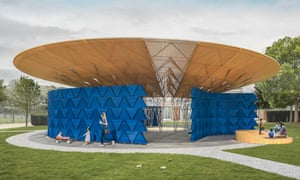
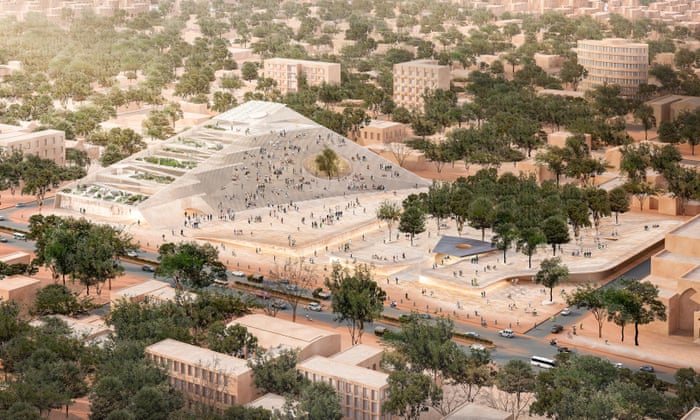
Like a rustic flying saucer ... digitally rendered design for Francis Kéré’s Serpentine pavilion.
Serpentine Pavilion by Francis Kéré

The architect is planning to bring one of his characteristically stripped-back structures, honed in the villages of his native Burkino Faso, to leafy west London.

Author |
Source: The Guardian Newspaper


A huge wooden disc will float above the lawn in Kensington Gardens this summer, a wheel of spindly timber slats hovering over a bright blue landing pad like some rustic flying saucer. This is the vision of Diébédo Francis Kéré, the first African architect to be chosen to design the annual Serpentine gallery pavilion, who plans to bring one of his characteristically stripped-back structures, honed in the villages of his native Burkina Faso, to leafy west London.

“The tree was always the most important place in my village,” he says, describing the inspiration for his design. “It is where people come together under the shade of its branches to discuss, a place to decide matters, about love, about life. I want the pavilion to serve the same function: a simple open shelter to create a sense of freedom and community.”

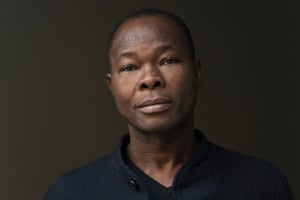
‘Remain true to how you started – but do a little bit more’ … Francis Kéré.
Photograph: Erik-Jan Ouwerkerk

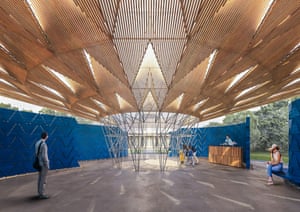
While the scorching sun might be the thing to shelter from in the deserts of west Africa, Kéré has configured his London canopy more with rain in mind, designing the shallow saucer to funnel water into a central opening, where a ring of slender steel trusses will support the great wooden bowl. The space will be loosely enclosed by a series of curving blue walls, formed of staggered wooden blocks in a textile-like pattern, a reference to the festive clothing worn by young men in his village on special occasions. “I’m coming to London,” he says, “so I wanted to show myself with my best clothes.”

In its frugal simplicity, the pavilion is a departure from recent years’ structures that have revelled in their sculptural novelty or shouted for attention with bright colours and synthetic materials. It is an apt reflection of Kéré’s work in Africa, where he has established an international reputation for designing sparing structures with mud bricks and lightweight steel frames, often built by unskilled labour with an elegant economy of means. Kéré initially considered using bricks for the pavilion walls, but was clearly advised against turning the royal park into a mud quarry.

The interior of Francis Kéré’s pavilion.
The interior of Francis Kéré’s pavilion. Photograph: Serpentine gallery


“I told myself, ‘Francis, don’t try to change yourself for this commission’,” he says. “Remain true to how you started, but do a little bit more. Here I have the chance to work with amazing engineers, so we can make the steel very thin and have an impressive cantilever.”

Kéré was born in 1965 in the village of Gando, a place with no running water or electricity, 125 miles southeast of the capital of Ouagadougou, making him unique as an architect who now moves in the glamorous circles of international biennales and professorships at Harvard. His face is still ringed with tribal scars in a pattern of spokes, marking him out as the son (and sun) of the village chief, a position of privilege that gave him the rare chance to attend high school in the city. At 18, he won a scholarship to study woodwork in Germany, but, realising there was not much use for carpentry in a country that has little wood, he switched to study architecture at the Technical University of Berlin.

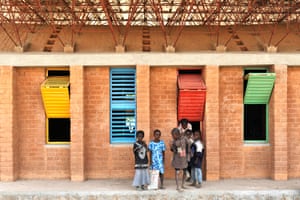
Gando school extension, developed out of Kéré’s final year university project.
Photograph: Erik-Jan Ouwerkerk

In his final year he designed a primary school for Gando and used his ample charisma and energy to raise enough money to see it built. The project was the first test of what would become his characteristic style of rural hi-tech: a pair of simple rectangular volumes made of mud bricks, crowned with a “flying roof” of vaulted corrugated metal. It won the Aga Khan award for architecture in 2004 and has since been expanded with a library, secondary school, teachers’ housing and a community centre.

Kéré was invited to become an emissary for the award, scouring the continent for other exemplar projects, but he had misgivings. “I stopped because everywhere I went they said, ‘Give us the tools to make good architecture before coming to ask for good architecture,’” he said in an interview. As a result, his motto is “help to self-help” – his projects place more importance on the process of local capacity-building than the finesse of the final product.

It is a collaborative, user-driven mode of practice that makes him an interesting choice for the Serpentine commission, which is essentially a hastily built stage set for hosting summer parties, usually then sold on to a collector. Might Kéré be employing local apprentice builders and trying to extend the impact of the project beyond being a diverting decoration for the lawn? “It would have been great, but it’s not easy working in this context,” he says. “The participation will happen when people come to take ownership of the structure, but I am working with partners to see if it can travel, and maybe end up in Africa as a museum or library.”


Kéré’s proposed Burkina Faso National Assembly and Memorial park. Photograph: Kéré architecture

Based in Berlin, where he runs a practice of 12 people, Kéré now uses commissions in Europe to subsidise the work back home, much of which is low-paid or pro bono. With one hand he designs boutique stores for shoe brand Camper and works on commercial masterplans in Germany; with the other he continues to build schools, health centres and libraries in India, Mali and Yemen, as well as an educational campus in Kenya, in the village where Barack Obama’s father was born. One of his most ambitious ongoing projects is the construction of an “opera village” in Laongo, near Ouagadougou, a world-class performance venue initiated by the late German theatre director Christoph Schlingensief, for which a school, clinic, art studios and a dozen homes have so far been built.

The Serpentine commission is just the latest in a series of international accolades Kéré has enjoyed over the past few years. As one of the few African architects with a global profile, he is continually courted by conferences and exhibitions around the world. He took part in the Royal Academy’s Sensing Spaces exhibition in 2014 (where he made a participatory tunnel of colourful straws), the Chicago Biennial in 2015, and the Venice Biennale last year, where he presented what could become the project of his lifetime, a new national parliament building for Burkina Faso.

“Most of the population has never seen higher than the height of a tree,” he says, describing his plan for a mountain-like building of staggered terraces, where people would be able to sit and enjoy views of the city. After the country’s 2014 uprisings, when the parliament was torched and the president was hounded out of the country after a 27-year reign, Kéré says there is an urgent need for openness and transparency. “The people will be able to climb above the politicians – what could be more symbolic?”

Tuesday, 21 February 2017

Mickaël Bethe-Selassié | Grand Master of Papier Mâché


Artist | Mickaël Bethe-Selassié
b. 1951 - Present
Origins: Ethiopian Artist Lives and Works in Paris, France

Solo Exhibition | Mickaël Bethe-Selassié
Exhibition: Chateau de Ladoucette, Drancy
Dates:  25th March - 21st May
Website: www.drancy.net

Grand Master of Papier Mâché is exhibiting over 70 works created over several decades. This is a wonderful day out for all the family.

Sunday, 19 February 2017

Jelili Atiku | Let Me Clutch Thee

Artist: Jelili Atiku
Origins: Nigeria
Performance: Let Me Cluth Thee
Location: Cape Town, South Africa
Date: Saturday 18th February 2017
Photos: Maye Albert

Here is the photo documentation of Jelili Atiku's performance, “Let Me Clutch Thee”, which was enacted with Tazme Pillay yesterday, Saturday February 18 2017 during the Institute for Creative Arts (ICA) Live Art Festival at Company’s Garden and Iziko South African National Gallery (S.A.N.G), Cape Town, South Africa.

The performance explored the persistence of oil spillage in the African continent, especially in the Niger Delta region, and its unprecedented impacts on ecosystem stability, biodiversity and food security. Organic and inorganic materials were employed to bring out the visual realities of the devastating effects of oil exploration and exploitation in the coastal region.

Photo by Maye Albert.