Wednesday, 16 September 2015

TRIBAL ART SALE | CHELSEA, LONDON


Lot 459 - Estimated £400 - £700 - PUNU-LUMBO SPIRIT FACE MASKS, five various from Gabon, Central Africa, carved wood, all but one white whitened faces, largest 38cm H, plus three display stands


Lot 460 - Estimated £150 - £250 - KUBA FACE MASK, D.R. Congo, carved wood, 66cm L x 18cm W maximum.


Lot 461 - Estimated £400 - £700 - DOGON TOGU'NA POST, Mali, of traditional form, carved figure, 182cm H, with bespoke stand.


Lot 462 - Estimated £600 - £900 - GREBO & KRU FACE MASKS, three various, from Cote D'Ivoire, with four eyes (2) and six eyes (1), largest 63cm H, plus a stand

Lot 463 - Estimated £400 - £700 - DOGON TRIBE FACE MASKS,Mali, three various carved wood, one the face of a monkey, another with bird surmount, the third a thin face, largest 56cm H.

 
Lot 464 - Estimated £150 - £250 - GURUNSI FACE MASK, Mossi people, Burkino Faso, carved in the form of a hornbill chased by a crocodile, carved wood with painted highlights, 83cm H, with display stand.


Lot 465 - Estimated £350 - £500 - KUBA SKIRT/LONG TEXTILE,

of substantial length worked panels with geometric designs,

embellished with cowrie shells, approximately 360cm x 85cm.


Lot 466 - Estimated £250 - £450 - DAN TRIBE STILT MASK, 
carved wood enclosed by a padded leather headdress ornamented 
with  horns, bells and cowrie shells, 36cm H x 37cm, plus a stand.


Lot 467 - Estimated £150 - £250 - DOGON GRANARY DOORS,

MALI, four various wooden examples carved traditional designs,

largest 39cm H x 31cm


Lot 468 - Estimated £200 - £400 - LARGE SONGYE KIFWEBE FACE MASK,
 D.R.Congo, carved wood in traditional form with hooded eyes and
striped detail, heightened in white, 58cm H, plus a stand.


Lot 469 - Estimated £250 - £450 - NUNA DANCING MASK,

from the Mossi people, Burkino Faso,carved wood in the form

of a hornbill bird, highlighted with traces of paint, 88cm H max


Lot 491 - Estimated £500 - £700 - DAN PEOPLE CEREMONIAL STILT MASK,

carved wood with a surround of coloured padded cloth, ornamented

with cowrie shells, grasses and feathers, plus stand.


Lot 492 - Estimated £150 - £250 - FANG FACE MASK,

carved wood heightened in white, approximately

61cm H x 20cm W maximum, plus stand.


Lot 493 - Estimated £500 - £700 - DAN PEOPLE

MASTER OF CEREMONIES STILT MASK,

carved wood with canvas and rope surround and drape,

ornamented with cowrie shells,

approximately 43cm H x 32cm W, plus double stand.


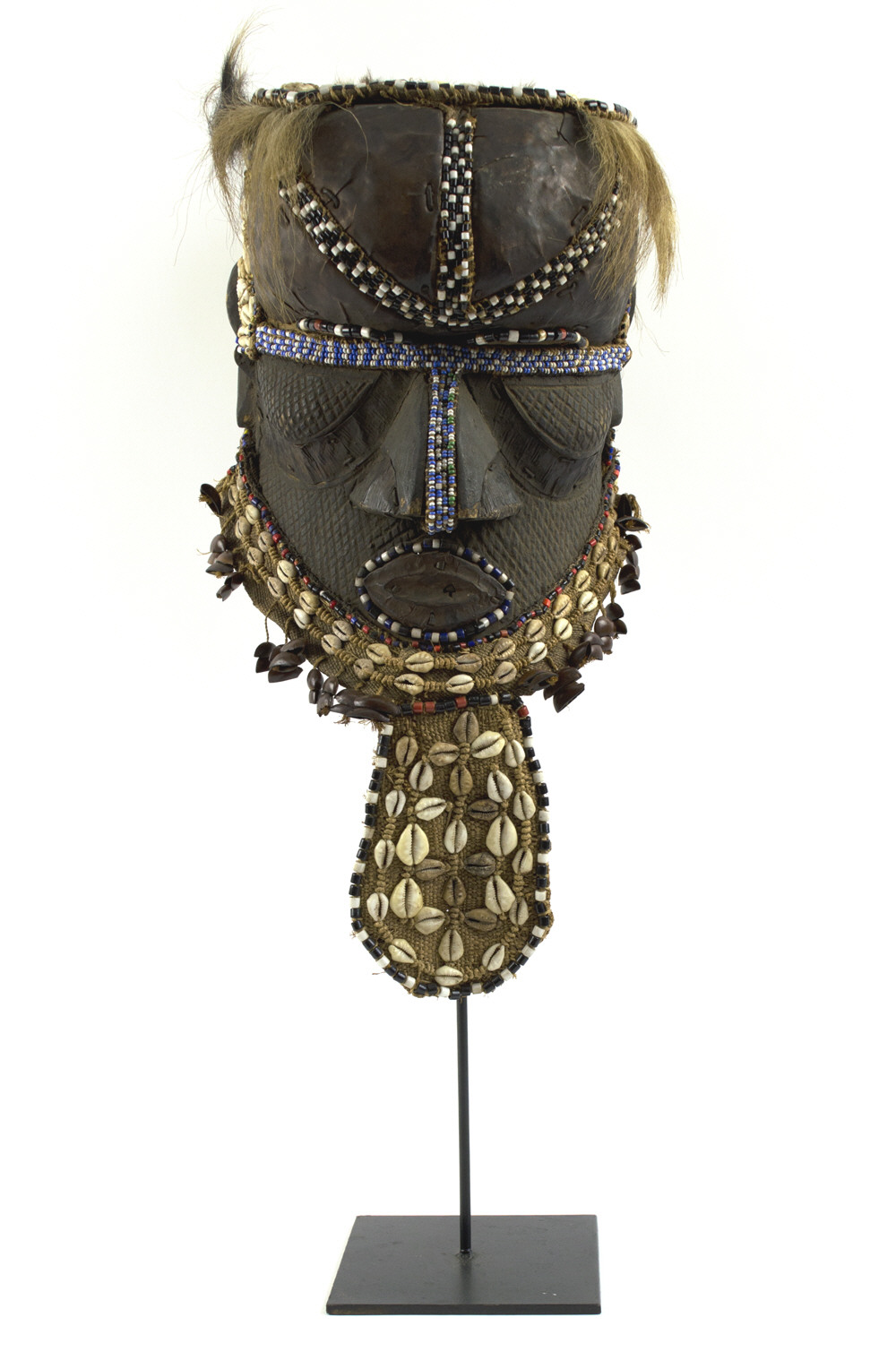
Lot 494 - Estimated £1500 - £2000 – ROYAL KUBA HEADDRESS,

circa 1940's, carved wood, ornamented with coloured beads,

cowrie shells, cola nuts and monkey hair,

approximately 35cm H x 24cm W, plus stand.


Lot 494A - Estimated £200 - £300 - BOBO BIRD FACE MASK,

carved wood with long beak, worked geometric decoration

heightened in white, approximately 71cm H x 14cm W.


Lot 495 - Estimated £800 - £1200 - KINGS GUARDIAN FIGURE,

Mumuye tribe, Eastern Nigeria, carved wood, standing, 96cm H.


Lot 496 - Estimated £300 - £500 - BOBO BIRD HEAD MASK,

Burkino Faso carved wood with geometric decoration,

heightened in white, approximately 71cm H x 30cm W, plus stand.


LOTS ROAD AUCTIONEERS | TRIBAL ART SALE

View Map

71 Lots Road Auctions,
Chelsea,
London,
SW10 0RN.
Tel: +44 (0)20 7376 6800
Fax: +44 (0)20 7376 6899
Email: info@lotsroad.com

Date: SUNDAY 20th SEPTEMBER 20015 

Time: 3pm

WEBSITE: LOTS ROAD SELECT TRIBAL ART


Saturday, 12 September 2015

Ifeoma Anyaeji | Owu (Threading)

Skoto Gallery
529 West 20th Street, 5FL
New York, NY 10011 212-352 8058


Owu, 2015, plasto-yarn, twine, wool and found object, 32x22x91 inches, 81x56x231cm
 
 
Ifeoma Anyaeji
 
Owu (Threading)
 
Sculpture
 
September 24th – November 7th, 2015
 
Skoto Gallery is pleased to present Owu (Threading), an exhibition of recent mixed media sculpture by the Nigerian-born artist Ifeoma Anyaeji. This will be her second solo show at the gallery. The artist will be present at the reception on Thursday, September 24th, 6-8pm.
 
Ifeoma Anyaeji’s recent work continues her exploration of discarded materials, its quality and physical nature, placing emphasis on process to activate a meaningful engagement and creative openness that strives to reinvigorate newly acquired techniques and ideas. Her work centers on the idea of up-cycling or concept of material re-use such as the ubiquitous non-biodegradable plastic bags and bottles into something of greater value and unorthodox, eliciting unique elements of ripeness and continuous growth. Using traditional hair plaiting techniques from her homeland, she threads and braids discarded plastic bags into plasto-yarns combined with a strong compositional ability into complex yet lyrical visual narratives filtered through cultural memories and contemporary realities that reflect subtle understanding of context and an awareness of the relationship between function and experimentation.
 
Ifeoma Anyaeji’s work is dense with visual complexity that reflects an awareness of a vast array of both formal and inherited traditions while exploring their aesthetic, sensual, and visual content to assert a different declaration, and a new way of making art. By imbuing mundane materials, marks and processes with surprising significance and intricate design, her work is transformed into an extraordinary visual poetry with rich textures of vibrations and pulsations that allow the viewer a freedom of imagination, interpretation and emotional response. The exhibition includes a strong selection of new works that are persistently innovative and demonstrate an awareness of the expressive possibilities of abstraction while encouraging us to probe into common elements of the human experience. “Queen Eliza” mimics the wannabe look of a young ‘fashionista’, merging a conspicuous, traditional and almost uncoordinated webbed hair-do with fancy psychedelic heels cropped from colonial fashion, challenging the line between newness and the new. ‘Made in ‘Shina’ speaks the language of an accrued compulsive material acquisition and an architectural build-up of these acquisitions – of course almost all made in ‘Shina’.
 
Ifeoma Anyaeji was born 1981 in Benin City, Nigeria. She obtained an undergraduate degree in Painting with honors from the University of Benin, Benin City, Nigeria in 2005 and as a Ford Foundation International Fellow, she obtained her MFA, Sculpture in 2012 at the Sam Fox School of Design and Visual Arts, Washington University, St Louis, Missouri, USA. She has participated in several solos and group exhibitions at home and abroad, including ‘Reclamation’, University of Missouri, Columbia in 2012 and Basket Case II, National Gallery of Zimbabwe, Harare, 2014. She was the Washington University in St Louis Nominee for the 2012 International Sculpture Center Outstanding Student Achievement Award. She is in several collections in Africa, Europe and the US. She is in the faculty at the University of Benin, Nigeria, and currently pursuing a PhD program at Concordia University, Montreal, Canada.
 
Artist Statement
Art is a limitless expressive tool of freewill. Therefore, its visual thoughts can serve to remind us that the limitation of one’s imagination is a limitation to one’s growth. And art devoid of optimistic imagination is art with limitations. As an artist, I have always had an interest in producing artworks that communicate with and integrate elements of and from my environment. This manifests in my choice of medium and style of rendition. My work is about the transitions of culture, the concept of recycling and material reuse, as a review of our cultural attitude to the ideology of product newness, value and the expiration date.
 
Through my works, I reflect on cultural descriptions of value and value systems drawn from elements that reflect social abnormalities. I am intrigued by process and the use of non-conventional materials as visual medium, like sand, wood and plastic, using the language of lines to transgress meaning and form and to replicate my memory of nature, the social and political. I am interested in the art of Up-cycling is to create a “new value” for that assumed to have lost its “newness”.
 
My concept of material reuse through the transformation of an object’s physical state, as an alternative to recycling by mechanized chemical disintegration, is to echo the environmental implication of accumulation and the extensiveness of a politicized archaeology of modernity’s consumptive system. This I conceive by creating a complexity of sculptural forms that allow for multiple interpretations of the functionality of an object after it has been consumed. I envisage a multiplicity of uses while retaining the physical state of the discarded object. I choose to work with conventional and non-conventional materials to create flexibility in my creation of forms.
 
The most recent of my non-conventional media are, two of the main global environmental pollutants, discarded plastic bags and bottles. I chose these pollutants based on their popularity in my home country Nigeria. With these I visually express the narrative of a domestic object’s possible transition from discarded to the aesthetic or functional – the transition from redundancy to utility. This style of art I have called Plastoart, coined from the words plastic and art.
 
The forms are conceived using the traditional craft skills of loom weaving and Nigerian hair Thread braiding (Threading) to manipulate the initial physical structure of my chosen medium. Braiding and weaving the plastic bags and up-holstering the plastic bottles with the bags enables me to conceive a complexity of sculptural forms that allow for a multiple interpretation of the potential functionality of these discarded mediums. With the spiraled patterned, fabric-like and organic forms I am able to make three and two dimensional forms. Most of the forms I make reference household furniture, architectural structures and fabric, like tables, chairs, wall partitions, tapestry and chair upholstering fabric.
 
My style reflects the environmental and is art for social engagement - an art for recreating economic value for these wastes. Thematically, I express an interplay of metaphorical themes drawn from traditional folklore, fashion, music and poetry. Used plastic bags may be tagged an environmental pollutant but to me it is a rich viable resource that must be exploited beyond its pre-designed use, even by an artist.
 
Ifeoma Anyaeji, 2015
Montreal, Canada


Saturday, 5 September 2015

Vasco Manhiça Solo Show in Maputo, Mozambique

"POINT OF VIEW" / "PONTO VISTA" (Works/Quadros)

Works To be seen until September 24th
Quadros para ser vistos até 24 de Setembro
@ Centro Cultural Português - Maputo
— in Maputo-cidade.

 
© Artist | Vasco Manhiça


"Point of View"
Mixed media on canvas
120x180 cm
2015, Maputo 

© Vasco Manhiça


"Press dePress"
Mixed media on canvas
Técnica mista sobre tela
2015, Berlin
© Vasco Manhiça

"Campaign Image"
Mixed media on canvas
80x80 cm
2015, Berlin
© Vasco Manhiça


"Arithmetic"
Mixed media on canvas
180 x100 cm
2015, Maputo

© Vasco Manhiça


"Black Man's Cry"
Mixed media on jute
120x180 cm
2015, Berlin/Maputo
© Vasco Manhiça


"Bitter Sweet Symphony"
Mixed media on canvas
Tecnica mista sobre tela
140x140 cm
© Vasco Manhiça


"Cage Brake"
Mixed media on canvas
Técnica mista sobre tela
140x140 cm
2015, Berlin
© Vasco Manhiça


Monday, 31 August 2015

Vasco Manhiça’s Point of View | Mozambique


The Process of Seeing: Vasco Manhiça’s Point of View
By: Erin M. Rice
21.7.2015

Vasco Manhiça’s newest body of work is a product of two formative years since his last show in Maputo in 2013. After a brief return to Germany, in 2014 he attended a residency program in Dakar called Àsìkò (run by the Centre for Contemporary Art, Lagos), which had a profound impact on his approach to art as an instrument of social critique. Informed and inspired by the politically and critically charged practices of the faculty that ran the Asiko program, Manhiça turned his practice in late 2014 away from painting to an extended period of intense reading and exploration of the theorizations of Africanity and postcoloniality as they relate to the art world. Early in 2015, Manhiça moved to Berlin, arguably Europe’s center for contemporary art. He connected with a network of artists, several of whom also come from Mozambique, and found amongst his contemporaries another rich source of influence and inspiration, stronger, he says, than that which he draws from the generations of artists that have come before him. This vibrant artist community, the energy of the city of Berlin and the groundwork laid in 2014 combined to create a space and time of intense productivity, resulting in the series of large-scale paintings that comprise Point of View.

The works in the new series are witness to the personal growth of the artist’s last two years. They demonstrate in their command of color, line, text and space a heightened confidence and articulateness. Moving fluidly between the political and the personal, these works can make specific cultural reference to Maputo or intimate relationships as easily as they broach subjects of universal relevance. ‘Mural do Povo’, for instance, references in the phrase my love I do not love you the Mozambican people’s feelings towards the flawed transit system of Mozambique’s capital city, while ‘Bitter Sweet Symphony’ alludes to love of a very different nature. 

Works such as ‘Global North’ and ‘Cage Break’, on the other hand, are infused with the experiences of an African living in Europe projected through the loud piece of the mass media. In particular, ‘Global North’ addresses those who are subjected to pitiless international migration policy as they seek a coveted visa to a country north of the socio-economic divide. Recent years have posed numerous new challenges to countries that border the Mediterranean including the Arab Spring uprisings, the ensuing unrest in Egypt, Libya, and the spread of ISIS. One of the results has been a drastic increase in migration from Africa to Europe, contributing to the largest global population of displaced persons and refugees ever witnessed. Tens of thousands of migrants seeking a better life in Europe have risked everything crossing the treacherous sea routes from North Africa for the shores of Italy and Greece but often are met with hostility, long internments in processing centers, a lack of jobs and opportunities, or worst of all: death at sea. 

Framed by an ominous arch of dark pigment, the words “je suis” appear in ‘Cage Break’, making clear reference to the catchphrase of solidarity that flooded social media after the shootings at the Paris offices of political satirist magazine Charlie Hebdo. Missing is the “Charlie” that completed the phrase, but in this absence is the implicit critique of the phrase’s hypocrisy as Europe condemns the actions of the attackers, while it simultaneously turns a blind eye to the plight of its immigrant populations. 

The statement also holds open the possibility and ambiguity of identity; je suis / I am is, in the intentional absence of a noun, a very simple declaration of existence, and the idea of identity as a process. This notion of process is perhaps more appropriate for people like Manhiça, and the countless who have followed the same trajectory before him, who have left their respective African countries for the West (including personal influences such as Fela Kuti), and in that act of leaving have found an affinity with their African identity, while at the same time their life in a foreign land has re-shaped the very notions of those foreign places, of home and of belonging. Upon return, however, stereotypes of the person who left Africa cloud the realities of the struggles he or she faced abroad.  This is the predicament of the artist returning home. 

For Manhiça, painting is a method of translating his experiences into a language that can be understood by those who have not had the same opportunities as him to see his country from the standpoint of someone who has left. Leaving Mozambique bestows a clarity, like hindsight, that only comes in departure and dis/re-location such that new viewpoints, free from the dominance of media, propaganda, or dogma can be formed and expressed. 

Vasco Manhiça’s latest works may be written in the language of expatriation, but what they unfold is a narrative about the journey of returning written for the people back home. 

Friday, 28 August 2015

Abeer Seikaly | Jordanian-Canadian Architect, Designer and Artist

Weaving a home...how one woman can help millions of people globally


A sustainable tent that collects rainwater, folds up for easy transport and stores solar energy? Sounds visionary, right? But this is the invention of Jordanian-Canadian architect, designer and artist Abeer Seikaly.

[IMAGE: Abeer Seikaly]

Seikaly designed these amazing multipurpose tents with refugees in mind, people who have been displaced by global and civil war, climate change and more. 

Inspired by elements of nature such as snake skin and traditional cultural aspects such as weaving, nomadic life and tent dwellings, this weather proof, strong but lightweight and mobile fabric tent gives refugees shelter but also a chance to "weave their lives back together".

The flexible dual layer tent structure has the ability to close out the cold of winter and wet weather. It also opens up to allow cool air in and hot air out in summer. Rainwater is collected in the top of the tent and filters down the sides so the tent does not become flooded. The tent also has the ability to become a showering facility with water being stored in pockets on the side and drawn upwards via a thermosiphoning system providing basic sanitation.

[IMAGE: Abeer Seikaly]

Solar energy hits the tent fabric and is stored in a battery for use at night providing renewable electricity.

[IMAGE: Abeer Seikaly]

For this amazing life changing structure, Seikaly has won the 2013 Lexus Design Award.
These tents also would make excellent shelter for people who have been displaced by natural disasters.

A simple but effective structure which has the potential to change so many lives across the world by providing some of the basic human rights to displaced people: a home, water and energy.

Source: 1 Million Women

Sidy Diallo from Senegal | Death of An Artist

Sidy Diallo at Brundyn

By Themba Tsotsi
04 September - 25 October.


Points et Iténeraire 2 et 1
Sidy Diallo
Points et Iténeraire 2 et 1, 2013. Acrylic and Pastel on Canvas Each: 200 x 150 cm.

From the 4 September to the 25 October 2014, Brundyn+ Gallery hosted Sidy Diallo’s exhibition 'Points et Itineraires'. Sidy Diallo is a painter from Senegal who works in a style that is inspired by lithography, a medium characteristic of many African artists. The exhibition is comprised of images that depict bridges and roads, whose forms seem to implicitly contain the anonymity of transition, and within Diallo's context they are further imbued with political connotations.

The way Diallo explores his interests within the medium has to do with the scale of the work; he incorporates paint and other materials like brown paper making the work multimedia in nature. In his style however, he quotes the traditional use of lithography within an African context which surrounds the issue of access – in this case the simple access to materials like paints and brushes. This of course has broader connotations.

Genese
Sidy Diallo
Genese 2014, Acrylic and Pastel on Canvas, Triptych: 133 x 133 cm each

Sidy Diallo distorts both the scale of the images and the canvas; instead of the dots and working surface being small they have been enlarged. In doing this Diallo maintains lithography’s sombre mystery, while at the same time retaining a boldness that evokes within the audience an immediate sense of nostalgia. Their difference, however, also lies in the sense that the images represent the immediacy of the contemporary discourse of forced migrations and exile. Here the large dots add to this effect distorting the image, conveying the anonymity of transition and the certainty of being identified as an exile, referencing a discourse in which the Diaspora lies implicit.

The backgrounds of the paintings are also depicted with dots as if the artist seeks to connect the figures to their circumstance. The large dots and the scale of the work in relation to the traditional themes of the lithograph are an attempt to depoliticize this state of affairs, the effect has a vitality that is contradictory to the plight of these embarcations as if now there is a freedom in them that only youth can realize.

The exhibition explores the underlying reasons for crossing borders in contemporary African society in the wake of phenomena like the slave trade, the diaspora and human trafficking. Throughout the exhibition there is the motif of the road or path, that connotes transitions which both seek to inculcate a form of limbo as well as forms of connecting. However, in the exhibition these paths or roads not only act as metaphors for transition, they are also metaphors for the fact that cultures are not informed by the progress of an encounter. In the case of Diallo’s migrations this is an encounter with diversity, and as a result they become, with the people who represent these cultures, barren as the roads they use to migrate.

La Traversee
Sidy Diallo
La Traversee
2014
Acrylic, pastel and paper on Canvas (4 panel painting)
270 x 270 cm
 
In Travel Masqued 3 – an acrylic, pastel and paper on canvas piece – a large male figure is walking on a narrow path or road with white hands and feet and appears to be contemplating or lamenting previous migrations. Not only is he connected to those who took this path in the past, he seems through his posture to physically appropriate their struggle. Furthermore the small figures on the edge of the canvas walking on another path, appear to be in an indeterminate state facing different directions. Their presence and disorientation suggests that the figure in the middle of the painting too is lamenting the strife or plight of embarking on the path.

There is, it seems, an almost binary opposition contained within the exhibition. The work E & A is a piece depicting two figures, one male painted brown and grey, the other female painted cream with an apple on the ground. The work seems to state that even though migrations are characterised by a lacking, when a destination is found there are nevertheless fruits to reap, not just in the encounter with diversity but also that the industry of transition can be realized. If there is anything sinister it lies in the treachery of the path, with its promise of fruit and sustenance, which are replete with the ambiguity of an arrival that does not necessarily mean success. However the other paintings in the exhibition are barren of the idea of reward. What the artist seems to suggest is that at the end of the path, an encounter with diversity and creativity is inevitable, but this does not guarantee a holistic success as is connoted by the bitten and discarded apple.

These ideas of success and frailty are brought together with presence of the bridge in the exhibition titled The Crossing. It speaks and is a metaphor for the universal forms of economic struggles, the discourse of innovation and the frailty of community development that can enforce migrations and crossings. In this sense the footbridge becomes the universal image of socio-economic frailty. It is a traditional foot-bridge with ropes and foot planks, extended from one end of the hall to the other – it effectively connects one painting to another.

Source: Artthrob | South Africa 

-----

Sadly this artist died this week.


2 years ago, I was blessed to be introduced by Barkinado Bocoum to a group of young talented and creative artists in Dakar who worked with me and young Brazilian artists during an exchange art project I had initiated. One of these artists was a very kind spirited, creative and promising young man named Sidy Diallo. Sidy was one of Senegal's rising Art stars, as he was being invited to participate in international exhibits and winning awards, notably at Dakar's last biennale. Like the rest of the group (Sol d'Art), I considered Sidy like a young Brother, and it was with great pleasure that I'd catch up with him every time I'd go to Senegal and see where his creativity was taking him.

A few days ago, I learned that Sidy had passed away, and I am still in shock. May his spirit guide the creative youth and souls of our World. I am in spirit with his family and friends. Life is short and we must DO. We must MAKE. Sidy MADE, and he will inspire us forever.

Peace and Beauty.
 
------


Décès du plasticien Sidy Diallo :Le jeune peintre au «talent prometteur» est mort


Le monde de la culture pleure encore un des leurs. Sidy Diallo, âgé de 28 ans est décédé samedi. Le «talentueux» lauréat du prix de l’Oif lors de la dernière édition de la Biennale de l’art africain contemporain de Dakar n’est plus. Selon la plateforme des arts visuels du Sénégal présidé par Viyé Diba, Sidy Diallo était l’un des plus talentueux de sa génération. Aujourd’hui, il a rejoint ses pères Pape Ibra Tall et Diatta Seck dans le royaume de la vérité. Le jeune peintre s’était révélé au monde des arts par son talent prometteur.

Major de sa promotion à l’école nationale des arts, avec une mention bien en 2013, il est sélectionné dès sa sortie dans l’exposition officielle de la onzième Biennale de Dakar. «Je me félicite de ce prix, comme j’ai eu à le dire, je viens de sortir de l’école nationale des arts. Aujourd’hui, je me retrouve sélectionné dans la plus grande Biennale africaine, c’est une grande chose dont je suis fière et le tout, je reçois le prix de l’organisation internationale de la Francophonie (Oif)» exprimait-il avec joie à la fin de la cérémonie. L’homme dont le travail consistait à apporter des réponses contemporaines par rapport aux questions de développement contemporaines qui affectent le continent africain est décédé la veille de son anniversaire. Toute l’équipe de Walfnet présente à sa famille ses sincères condoléances.

-------