Wednesday, 22 April 2015

KUBA DESIGNS FROM CENTRAL AFRICA - CONGO


A Bakuba woman weaving a textile


Kuba Textiles

Kuba textiles are unique in the Democratic Republic of the Congo, formerly Zaire, for their elaboration and complexity of design and surface decoration. Most textiles are a variation on rectangular or square pieces of woven palm leaf fiber enhanced by geometric designs executed in linear embroidery and other stitches, which are cut to form pile surfaces resembling velvet. Women are responsible for transforming raffia cloth into various forms of textiles, including ceremonial skirts, ‘velvet’ tribute cloths, headdresses and basketry.

Raffia Cloth

In Kuba culture, men are responsible for raffia palm cultivation and the weaving of raffia cloth. Several types of raffia cloth are produced for different purposes, the most common form of which is a plain woven cloth that is used as the foundation for decorated textile production. Men produce the cloth on inclined, single-heddle looms and then use it to make their clothing and to supply foundation cloth to female members of their clan section. The cloth is coarse when it is first cut from the loom, so it is then pounded in a mortar, which softens it and renders it ready for the application of surface decoration, for which women are responsible. 

Twool

Many prestige weavings are dyed with twool, a deep red substance obtained from the heartwood of the tropical trees Pterocarpus sp. and Baphia pubescens. The Kuba believe that twool is imbued with magical and protective properties. When mixed with palm oil, it creates a pomade that is applied to the face, hair and body in a ritual context. According to oral tradition, the Pende were responsible for teaching the Kuba how to weave textiles; the Pende used twool to die their prestige clothes for death
rituals. 

"Bambala" Fabrics

Early 20th Century ethnographer Emil Torday acquired the oldest group of extant textiles from the Kuba tradition from the reigning king, Kot aPe. He called these textiles "Bambala" after the ruling clan. According to Joseph Cornet, these cloths were embroidered by Bushong women who were pregnant with the King's heirs for use in rituals surrounding the birth of the children.[5] They were also used as funerary regalia for noble women. The slight sculptural relief, elaborate geometric designs and technical cohesiveness of the textiles indicate that they were created by highly skilled elders. According to art historian Drake Moraga, "That Kuba embroiderers represented textile structures in their compositions underscores both the value of weaving to the culture and the prestige attached to women art." 

Women's Ceremonial Overskirts
 
Bushong woman's ceremonial
overskirt from the 20th century.

Kuba women traditionally wore overskirts during burial displays, but the overskirt was later adopted as part of many ceremonial ensembles worn during ritual dances, celebrations and masked performances. The wraparound skirt was secured with a belt and worn over a typically monochrome red or white embroidered skirt. These skirts exhibit a variety of design components; some skirts employ flat linear embroidery exclusively, while others employ this technique exclusive on the borders of the fabric, in which case the interior is executed with cut-pile embroidery, which lends the surface a "plush" appearance and feel. In the cut-pile embroidery technique, short raffia strands are individually inserted with a needle under one or more warps or wefts of a plain-woven raffia panel, then cut close to the surface at each end to produced the raised "pile." Textile weaving boasts a variety of motifs, such as guilloche interlace, which embroidery artists employed along with color, line and texture to yield varied compositions and visual effects. 

Pattern and Repetition: Kuba Textiles as they Relate to Mathematics and Music
 
Kuba cloth from early-mid 20th century, currently at the Honolulu


Academy of Arts

Kuba textiles demonstrate a taste for interrupting the expected line; they compose through juxtapositions of sharply differing units and abrupt shifts of form.

Mathematician Donald Crowe has analyzed, in particular, the two-dimensional designs of Benin, Yoruba and Kuba arts and has shown the extent of the Africans' explorations into the formal possibilities of geometric variation. In their art, the Kuba have developed all the geometric possibilities of repetitive variations of border patterns, and of the seventeen ways that a design can be repetitively varied on a surface, the Kuba have exploited twelve. This exploration does not mean that they confine themselves to repetitive patterning in confronting a surface to be decorated.

The character of Kuba design accords with Robert Thompson's observation that some African music and art forms are enlivened by off-beat phrasing of accents, by breaking the expected continuum of surface, by staggering and suspending the pattern. In textile design, the Africans of the Kasai-Sankuru region do not project a composition as an integrated repetition of elements. Until recently, Euro-American attitudes on this point were so fixed that we called a textile design a "repeat," and expected to find a unit of identical imagery repeated over the surface. This kind of integration is not typical for African two-dimensional arts.

N.B. If we look at the Chief and what he is wearing and the designs he is seated on we would, if we were in the blazing sun, see him as floating above the earth. This is the power of the Kuba Designs.

Let Us Push These African Design Ideas To The MAX.

Here are some new works by Joe Pollitt from the UK, inspired by Kuba Designs from the Congo and Central Africa including Uglorious Ugandans. Here we see ideas that thread mathematics, knot theory, universal symbols that appear all over the world and the origins of African magic being introduced globally but what are all these powerful messages trying to teach us?


Kuba Shoowa Textile Kasai Velvet | POLLITT COLLECTION


Stage 1 | Uglorious Designs


Stage 2 & 3 | Uglorious Designs


Stage 4 & 5 | Uglorious Designs

Stage 6 | Uglorious Designs


The designs when layered take us into a different dimension. A two dimensional design when miss matched and crossed over send our minds into a sense of flying, uplifting movement so we see above and below. When lives are lived outside rather than inside the use of light or daylight can be harnessed to improve the mental state of all. These designs are key as the wearer twist and turn and do so next to similar designs so our eyes are tricked into a sense of three dimensional imagery that has never been seen before. Human movement coupled with complex designs is a source of visual alchemy. This is the true magic of Art and yet again coming out of Central Africa including Uganda.

Let us look at this from a Ron Eglash perspective of mathematics and the use of fractals at the heart of rural African village planning. 


Let us pick up on what Luke Dunn stated about the similarity of the Dogon people of Mali, they are well know to be the great mathematicians and astrologers with an in-depth knowledge of the cosmos. Their mapping of Sirius B is stuff of legends - Dogon People of Mali.


Dogon Designs


This lecture by Dr Van Sertima is enlightening and goes into areas of Africa that we are discussing with great depth and is a very useful resource for those interested in this area of intellectual debate about the importance of mathematics, design, primitive thought that is process even in today's standards and echoes much of what we have previously discussed.


*N.B. These are interesting articles sent to us by Joanne Muwanga.

Tyehimba

The Ishango Bone: Evidence of the Congolese Invention of Mathematics

By Robin Walker

Mathematics was born in Central Africa at least 25,000 years ago.  The evidence comes from the Ishango bone, a prehistoric tool handle.

It was unearthed by archaeologists working in the Ishango region of Congo on the shore of Lake Edward. Jean de Heinzelin of Belgium's Royal Institute of the Natural Sciences discovered it in the late 1950s. Originally thought to have been over 8,000 years old, a more  sensitive re-dating by Alison Brooks of George Washington University has established that the bone tool is an astonishing 25,000 years old.

We would do well to ponder over this date. Civilisations as we know them did not exist. Africans had already developed fishing cultures by then and had already dug the world's first mines. They also began the observation of the heavens. Outside Africa, much less has happening. It must be remembered that the period of which we speak  was at least 22,000 years before the first Greek cities, the crowning achievement of the Europeans. This period was 20,000 years older than the first Middle Eastern kings. Even in Africa, where civilisation began, Ishango was an achievement. This artefact is at least 16,000 years older than the construction of the Great Sphinx  of the Giza desert, the crowning achievement of the African people of the Nile River.

So what is so special about this bone? On the tool are three rows of notches, two of which add up to sixty. The number patterns represented by the notches have been analysed by many scholars, most notably by Professor Claudia Zaslavsky, a European-American mathematician. She demonstrates that the number patterns show doubling, addition, subtraction, prime numbers and base ten. The patterns have also been analysed by brilliant and scholarly Charles Finch, one of Black America's best intellects.

The first row of patterns on the bone shows three notches carved next to six, four carved next to eight, ten carved next to two groups of five, and finally a seven. The numbers 3 and 6, 4 and 8, and 10 and 5, are believed to represent the process of multiplication by 2. Row 2 shows eleven notches carved next to twenty-one notches, and nineteen notches carved next to nine notches. This is thought to represent 10 + 1, 20 + 1, 20 – 1 and 10 – 1. Finally, row 3 shows eleven notches, thirteen notches,
seventeen notches and nineteen notches. 11, 13, 17 and 19 are the prime numbers between 10 and 20. A prime number can only be divided by itself and by 1 to produce a whole number.

The early mathematician(s?) responsible for the Ishango bone therefore understood multiplication, addition and prime numbers. Moreover, two of the rows add up to sixty. Row 2 consists of 11 + 21 + 19 + 9 = 60. Row 3 consists of 11 + 13 + 17 + 19 = 60. Our leading writer on ancient African science, Charles Finch of the Morehouse School of Medicine, believes that this represents an understanding  of base 60. This is, incidentally, the concept on which modern clocks and watches are based. For example, on a modern clock 60 seconds = 1 minute, and 60 minutes = 1 hour. Finally, the centrality of numbers ten and twenty for the calculations in row 2 and row 3, suggest an early understanding of base 10. This is the basis of the  decimal system of counting, the very one that we use today. For example, on a modern decimal ruler 10 millimetres = 1 centimetre, and 10 decimetres = 1 metre.

It is heartening to see that information about ancient African mathematics inspires people today. In England, for example, Elizabeth Rasekoala, a Manchester based chemical engineer, established the Ishango Science Clubs early in 1997. These clubs were part of an initiative by her charity The African-Caribbean Network for Science & Technology to promote mathematical and scientific excellence among Black school children in various  British cities. Their impact has already been felt.

We may never find out who the Congolese mathematician(s) was/were who carved the number patterns on the Ishango bone, but their list of distinctions are many. They presented the world's oldest known counting system. They were the first known people on the planet to present multiplication, addition, subtraction, prime numbers, base 10 and base 60 (if Charles Finch is correct). They did this sometime around 23,000 BC, that is 25,000 years ago! It is sometimes suggested that many Black school students are failures at mathematics and in the sciences. It is also suggested that teacher racism, broken families and the lack of role models are valid explanations for this shabby state of affairs. In all honesty, do these excuses stand up when Africans invented the subject 25,000 years ago?

------

Ancient African Mathematics

Source: Taneter | http://www.taneter.org/math.html

Africa is home to the world's earliest known use of measuring and calculation, confirming the continent as the birthplace of both basic and advanced mathematics. Thousands of years ago, Africans were using numerals, algebra and geometry in daily life. This knowledge spread throughout the entire world after a series of migrations out of Africa, beginning around 30,000 BC, and later following a series of invasions of Africa by Europeans and Asians (1700 BC-present).

Measuring and Counting

Lebombo Bone (35,000 BC)

The world's oldest known measuring device, the "Lebombo bone
The oldest mathematical instrument is the Lebombo bone, a baboon fibula used as a measuring device and so named for its location of discovery in the Lebombo mountains of Swaziland. The device is at least 35,000 years old. Judging from its 29 distinct markings, it could have been used to either track menstrual or lunar cycles, or used merely as a measuring stick.

It is rather interesting to note the significance of the 29 markings (roughly the same number as lunar cycle, i.e., 29.531 days) on the baboon fibula because it is the oldest indication that the baboon, a primate indigenous to Africa, was symbolically linked to Khonsu, who was also associated with time. The Kemetic god, Djehuty ("Tehuti" or "Toth"), was later depicted as a baboon (also an ibis), and is usually associated with the moon, math, writing and science. Use of baboon bones as mathematical devices has been continuous throughout all of Africa, suggesting Africans always held the baboon as sacred and associated with the moon, math, and time.

Front and rear of Ishango Bone in the Museum of Natural Sciences, Brussels
Ishango Bone (20,000 BC)

The world's oldest evidence of advanced mathematics was also a baboon fibula that was discovered in present-day Democratic Republic of Congo, and dates to at least 20,000 BC. The bone is now housed in the Museum of Natural Sciences in Brussels. The Ishango bone is not merely a measuring device or tally stick as some people erroneously suggest. The bone's inscriptions are clearly separated into clusters of markings that represent various quantities. When the markings are counted, they are all odd numbers with the left column containing all prime numbers between 10 and 20, and the right column containing added and subtracted numbers. When both columns are calculated, they add up to 60 (nearly double the length of the lunar or menstrual cycle).

A Gebet'a carving on the base of an Aksumite tekhen (stela), courtesty of Indech


Rwandans playing Omweso, a more advanced version of Gebet'a
Gebet'a or "Mancala" Game (700 BC-present)

Although the oldest known evidence of the ancient counting board game, Gebet'a or "Mancala" as it is more popularly known, comes from Yeha (700 BC) in Ethiopia, it was probably used in Central Africa many years prior. The game forces players to strategically capture a greater number of stones than one's opponent. The game usually consists of a wooden board with 2 rows of 6 holes each, and 2 larger holes at either end. However, in antiquity, the holes were more likely to be carved into stone, clay or mud like the example from Medieval Aksum, shown at right. More advanced versions found in Central and East Africa, such as the Omweso, Igisoro and Bao, usually involve 4 rows of 8 holes each.

Fractions, Algebra and Geometry

A copy of the so-called "Moscow" papyrus in "hieratic" text, with a clearer rendering below in "hieroglyphs".
"Moscow" Papyrus (2000 BC)

Housed in Moscow's Pushkin State Museum of Fine Arts, the so-called "Moscow" papyrus, was purchased by Vladimir Golenishchev sometime in the 1890s. Written in hieratic from perhaps the 13th dynasty in Kemet, the papyrus is one of the world's oldest examples of use of geometry and algebra. The document contains approximately 25 mathematical problems, including how to calculate the length of a ship's rudder, the surface area of a basket, the volume of a frustum (a truncated pyramid), and various ways of solving for unknowns.


"Rhind" Mathematical Papyrus (1650 BC)

Purchased by Alexander Rhind in 1858 AD, the so-called "Rhind" Mathematical Papyrus (shown below) dates to approximately 1650 BC and is presently housed in the British Museum. Although some Egyptologists link this to the foreign Hyksos, this text was found during excavations at the Ramesseum in Waset (Thebes) in Southern Egypt, which never came under Hyksos' rule. Written by the scribe, Ahmose, in the "Hieratic" script, the text reads as follows:


"Accurate reckoning for inquiring into things, and the knowledge of all things, mysteries...all secrets... This book was copied in regnal year 33, month 4 of Akhet, under the majesty of the King of Upper and Lower Egypt, Awserre, given life, from an ancient copy made in the time of the King of Upper and Lower Egypt Nimaatre. The scribe Ahmose writes this copy..."


The first page contains 20 arithmetic problems, including addition and multiplication of fractions, and 20 algebraic problems, including linear equations. The second page shows how to calculate the volume of rectangular and cylindrical granaries, with pi (Π) estimated at 3.1605. Tere are also calculations for the area of triangles (slopes of a pyramid) and an octagon. The third page continues with 24 problems, including the multiplication of algebraic fractions, among others.

A page from the so-called "Rhind" Mathematical Papyrus in "Hieratic" text.


Timbuktu Mathematical Manuscripts (1200s AD)

Timbuktu in Mali is home to one of the world's oldest universities, Sankore, which had libraries full of manuscripts mainly written in Ajami (African languages, such as Hausa in this case, written in a script similar to "Arabic") in the 1200s AD. When Europeans and Western Asians began visiting and colonizing Mali from 1300s-1800s AD, Malians began to hide the manuscripts in basements, attics and underground, fearing destruction or theft by foreigners. This was certainly a good idea, given Europeans' history of stealing and/or destroying texts in Kemet and other areas of the continent. Many of the scripts, such as the one shown below, were mathematical and astronomical in nature. In recent years, as many as 700,000 scripts have been rediscovered and attest to the continuous knowledge of advanced mathematics and science in Africa well before European colonization.

A famous example of a mathematical and astronomical manuscript from medieval Timbuktu


Friday, 10 April 2015

Forbidden Medicine by Ellen Brown


Source: Amazon

This is the true story of a man who cured himself of a near-fatal cancer after conventional medicine had mutilated and then abandoned him. He spent the next thirty years helping others with the disease. In the struggle to keep his clinic open, he faced raids and robberies, a near-fatal beating, a kidnapping, and a prison sentence many called justice gone wrong. The details of his therapies, and the history and vicissitudes of the non-traditional health care movement that his life personifies, are woven throughout his story. While politicians debate how to impose Modern Medicine on us all, this story needs to be retold.

Review

Jimmy Keller has helped hundreds of people, a truly great and compassionate human being who has been persecuted, beaten near death and attacked for 20 some years because he healed cancer naturally. What an incredible irony. Millions of Americans have died from cancer in the last 20 years, yet here we have a man who can put about 90% of people (who have not been treated with chemotherapy/radiation) into lengthy remission using natural non-toxic therapies, but he is attacked and imprisoned for saving lives. Why? -- Gavin Phillips, Highly Recommended Books, CancerInform.org

Keller's story highlights the sharp divide between orthodox and alternative/holistic approaches. Five stars. -- Cancer Monthly, Best Picks, 2005

The need for alternative viewpoints and a broader spectrum of analysis is widely needed, and is fulfilled in Forbidden Medicine. At a stage in the evolution of mankind in which we need to pool all efforts towards a better understanding of the healing process, Ellen Brown's writings prove to be a valuable contribution. -- Carlos Warter, M.D., Ph.D., author of "Recovery of the Sacred," "The Soul Remembers," "Who Do You Think You Are."

The story of Jimmy Keller, a purveyor of formulas said to cure cancer, and a purported "quack," is a story every American should know, and every cancer patient should take to heart. The cancer statistics speak for themselves -- "the war on cancer" is a travesty. -- Irene Alleger, Townsend Letter for Doctors and Patients, August 2001

About the Author

Ellen Brown developed her research skills as a litigating attorney in Los Angeles. She is the author of 11 books, including the bestselling "Nature's Pharmacy" co-authored with Dr. Lynne Walker. Her latest book is "Web of Debt" (2007, 2008), on the Federal Reserve and the money system.

Customer Review

It always struck me as odd that one of the so called "cures" or inhibitors of cancer was poison (chemotherapy). Why would you want to poison your body in order to get healthier? "Forbidden Medicine" confirmed my suspicions and put me on to a more logical path. Jimmy Keller, while not a medical doctor, appears to be gifted in not only detecting cancers, but in eliminating some and putting others into remission. His use of Tumorex to shrink tumors has been an effective natural medicine and is a non-toxic cancer treatment. After reading "Forbidden Medicine" and given the decision of traditional over non-traditional and non-toxic therapies, there is no doubt in my mind that I would choose the latter. Read the testimonials alone, at the end of the book, and you decide for yourself.

It is a travesty of justice that Jimmy Keller is in jail, while many could be benefiting from his knowledge and the positive results of his treatment. Ellen Hodgson Brown, lawyer and author, has brought to light the injustice of Keller's sentence and has revealed the more sordid side of the pharmaceutical companies and the American Medical Association's attempts to block alternative medicines to treat cancer.


Tuesday, 7 April 2015

Shona Sculpture

Joram Mariga | 1927 - 2000

Source: www.zimsculpt.com

The career of Joram Mariga is inextricably linked with the beginning of Zimbabwean stone sculpture movement.

jorammariga

Born of artistic parents in 1927, Mariga used to watch his father and brother carve wood, and his mother make open-fired ceramics. Experimenting with wood carving at first, he moved onto soft stones such as Steatite, but later discovered colourful, harder stones with which to work and became committed to this new material. Others, on seeing his work, asked to be taught the skill and his influence gradually spread.

It was essential to Mariga in the early days, to return to close contact with Shona customs and the significance of the natural world.

His knowledge of the early days ensures that he remains a powerful example to artists today, amongst whom he is regarded with affection and respect, being referred to as the Father of Zimbabwe Sculpture.
McEwan stated ‘The sculptural expansion developed in only 34 years.  To give a true example, among others arriving from different parts of the country came Joram Mariga. He was not the first to come to the workshop, but one of the best…He brought me a little milk jug carved in soft stone. I realised this was an English milk jug for an Englishman who loved his tea!  I asked if he could make a head.  The head came, made also for an Englishman, in the style of airport art as acquired by tourists.  “If you made a figure for your own family or your ancestors?” I asked.  “Oh, that would be different.”  The figure came, this time of pure African concept – the enlarged head, seat of the spirit, a frontal static pose, a visage staring into eternity with formally posed arms and clenched fists.  It was pre-Columbian in nature, as if a spirit image applied to stone could create similar results in spite of a difference of race, place and time.”
Joram died in December 2000 aged 73 years old after a car accident.

Untitled by Joram Mariga

Stone: Springstone


ZimSculpt are selling this sculpture on behalf of Maud Mariga, the late Joram Mariga’s wife. We can confirm this is an original Joram sculpture as it has been on display at Maud and Joram’s House for years. There are further pictures of this sculpture available, including pictures of Maud with it. ZimSculpt will not take any commission for this sculpture, in respect for the late Joram Mariga.


Saturday, 4 April 2015

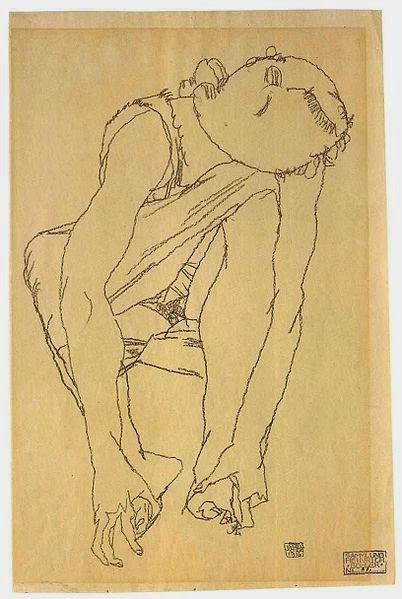
From Egyptian Sexuality to Modern Women Pleasing Themselves. Female Nudes from Gustav Klimt and Egon Schiele.


After watching the Egyptians let us move into our present Modern with Gustav Klimt and Egon Schiele

Contributions by Alessandra Comini, James T. Demetrion, Johannes Dobai, and Thomas M. Messer
Published in 1965
124 pages

Softcover


This publication brings together the work of two Austrian artists—Gustav Klimt and his former student Egon Schiele. Although independent in their style and depiction of their subject, common threads are manifest in the oeuvre of both artists. The two share a certain anxiety and preoccupation with the erotic, yet stylistically Klimt's work is formally ordered and decorative while Schiele's work is unforgiving in its brutality. This exhibition focuses specifically on the output produced late within Klimt's career, while approaching Schiele's work from a retrospective standpoint. The catalogue discusses each artist separately and includes a chronology, essay, and an illustrated exhibition checklist, providing an engrossing insight into the work of two distinctive artists who can be credited with catalyzing the transition from Art Nouveau to Expressionism. When considered together the vibrancy and singularity of each body of work is made evident.

Excerpt
Where Klimt is ornamentally decorous, Schiele is often indecorously expressive. Klimt's meticulously structured mosaic compositions are opposite in concept and execution from Schiele's sure and daring linear scheme, as are Klimt's subtly balanced tonal effects when seen in juxtaposition with Schiele's fauve and eventually expressionist use of color. Klimt strives through formal means to attain an order that, not unlike Mondrian's, reduces spontaneous and individual components to a collective validity. Schiele, in contrast more like Klee, transcribes highly personal insights which then assume the power of evoking common experiences. Above all, Klimt, despite his current relevance to modern art, must be seen as a late exponent of an historic style, whereas Schiele raises to the most intense pitch the newly acquired awareness of 20th century man. Together, Klimt and Schiele signify an end and a beginning, and at one poignant moment their adjoining forms point simultaneously backward and forward to comprise the past and future in a fleeting present.

This is the documentary about the first for The Lady in Gold - An Austrian National Treasure - Stolen by the Nazis.


Friday, 3 April 2015

Tuesday, 31 March 2015

Stainglass from Uganda

Mathias Muwonge Kyazze | Master of Glass Art

Mathias Muwonge Kyazze

How did you go about becoming an artist?

I was always interested in drawing geography maps and science drawings at primary school.  At home, I was involved in mat weaving and basket making. I started formal art classes in Senior One. Senyondwa Deus was then my best friend. He is now a lecturer at Kyambogo University. He inspired and encouraged me because he was a better drawer. I studied art through high school to attaining a Masters degree.  I am still practicing, and becoming more of an artist.

 Image

What are you working on at the moment?

I am working on two major stained-glass design projects. One at St. Charles Lwanga Church in Ntinda near UNEB, and another at St. Joseph’s Church, Nansana.

Image

Where do you see your art practice in the next five years?

It is difficult to predict because it depends so much on the design commissions I receive. I the meantime, I am thinking of developing more into an art and design consultancy.

 Image

Can you tell me about an artist whose life/work you really like?

Prof. G Kyeyune’s paintings and sculptures inspire me a lot. So do (Mary) Naita’s.

 Image

What would you say in a short text message to an aspiring artist?

Getting to know what other artists have done, and written about in art and related disciplines, is key to shaping one’s art practice.


Image

Mathias Muwonge Kyazze can be reached at +256 777 912 122

Art, Artists and Art Criticism

Emmanuel Jegede | The Sacrifice

Art, Artists and Art Criticism
Situational Report in Nigeria from 1950 – 2004

Introduction

This article is focused on some issues concerning contemporary art and its practitioners and art critics as it relates to Nigeria from 1950 to date. In any way the article may not be able to discuss in minute detail due to space constraint. At the same time the theoretical framework of the paper will be historical and also analytical in order to be able to state the author’s views on some issues raised here.

The history of contemporary art in Nigeria cannot be complete without referring to the instrumental figures who through their solo efforts brought Nigerian modern art into the world art history. The history started with Aina Onabolu 1881-1963 as a leading figure who did not only start the art of drawing and painting but also fought single handedly to put art in the school curriculum in 1927. Onabolu consciously went into art of figure drawing and painting to prove and disabuse the minds of the then Europeans who thought no African can dabble into the art of figure drawing and painting. With the help of some European art teachers such as Kenneth Murray who came in 1927, H.E Duckwork and Dennis Duerden who later joined, they later discovered of other talented indigenous artists who did not only continue from Onabolu, they equally made their distinct landmark in the propagation of visual art. Such notable artists include Akinola Lasekan 1921-1972, Justus Akeredolu1915-, Ben Enwonwu 1921 – 1994, Etsu Ngbodaga and others.

These notable Nigerian academically trained, or partially trained or self trained artists started what was later christened Natural Synthesis by the “Zarianist”. For example, Enwonwu’s paintings and sculptures reflect naturalistic and stylized forms which he called “African Style”. As it is argued, Enwonwu’s spirit of synthesis later became the compass upon which the Zarianists members of Zaria Art Society based their popular theory of “Natural Synthesis”. Ademuleya,2003.

The events starting from 1950 have been very topical and have also dictated the trends in contemporary Art in Nigeria. Also events since then have been properly classified by some scholars who wrote on contemporary Nigerian art. These scholars include Dele Jegede 1983, Adepegba 1995, Akatakpo, 1995 Kunle Filani 1998.

Late 1950s and early 1960s witnessed in Nigeria art history the beginning of radical revolution in visual art. The periods consciously witnessed the change of art style from ancient traditions and also jettisoning of western – style realistic approach to execution of artwork. The new consciousness ushered in what was referred to by Filani as “New African” concept which simply means an admixture of traditions and modernism, the philosophy which was later developed as “Natural Synthesis”. This philosophy in the first formal Art School in Nigeria. That is, the college of Art, Science and Technology, Zaria which was later renamed Ahmadu Bello University ABU Zaria. The key actors of this great African philosophy in visual art, who started as students and later spread into various art schools after their graduation are Yusuf Grillo, Uche Okeke, Bruce Onobrakpeya, Demas Nwoko, Emmanuel Odita, Jimoh Akolo, Solomon Wangboje and a host of others. They formed what was known as Zaria Art Society. .


The artists mentioned above influencee other followers and students who have some common and unique characteristics which reflect in their individual works. For decades they dictated the trends in Nigerian contemporary art. Their ideologies according to Filani were carried to other formal schools or workshops to create vibrant artistic revolution Filani 1998:35. Some of these pioneer artists are still in contention in the country.

Another generation of Artists who were later discovered after the 1950s and 1960s progenitors are 1970s graduates of mostly the Zaria Art School. Among them are Shina Yusuf – painter now dead, Joshua Akande – painter, Nelson Cole – painter now dead, Dele Jegede – painter, cartoonist and critic, David Dale – painter and mosacist, Kolade Oshinowo – painter and Gani Odutokun- painter now dead. Their works have been described as characterized by elongation of forms, with elegant northern architecture, and human figures while some depict northern grassland in their landscapes. Most of these artists’ works are in the collection of National Gallery of Modern Art. It is worth mentioning that artist like Late Professor Adepegba 1941 – 2002 who graduated in 1971 with 1st class degree in sculpture consciously went into art history and criticism. He made his mark as one of the distinguished, outstanding and foremost Africanist Art Historians/Critic the Continent has ever produced.
Most contemporary Nigerian artists are classified along the school in which they graduated from. There are also cases of few artists having other distinct styles or deviating from the usual school styles.
Of large number of contemporary artists in the practice today are the 1980s graduates of various formal art schools in Nigeria. The term “school” is also used to describe the philosophy, styles, themes and forms that are peculiarly distinguishing of these schools. The schools that have distinguished themselves with some unique characteristics include Zaria School, Yaba School, Nsukka School, Ife School and Auchi School

The distinguishing characteristics of each school will be briefly mentioned as well as some of their outstanding products or artists. The name of the school represents the location of each art school or may some time bear the name of the founder.

Some Agents of Contemporary art in Nigeria
Zaria Art School
The works of the school are characterized by elongation of forms, with elegant northern architecture and human figures. Their landscapes, most times reflect the grassland and savannah vegetation of the North. Other later graduates of the Zaria School who have made their marks from 1950s till date as artists, teachers and historians include Prof. Yomi Adetoro, Dr. Tunde Akinwumi, Jerry Buhari, Jacob Jari, Tonie Okpe, Rukeme Noserime, Nse-Abasi Inyang, Tunde Balogun, Tunde Oniyide, Tony Emordi, Victoria Ukpera, Chinwe Abara, Abraham Uyobusere, Akeem Balogun, Wunmi Busuyi, Betty Bassey, Duke Asidere, Emmanuel Irokanumo, Ade Odun, Taiwo Oyejide0 and Abiola Idowu among others. Their contributions have been in the sustenance of the art tempo which the pioneers started through their constant practice. While some of the listed artists are household names among the art historians, critic, collectors and the art audience, some talents are just emerging.

Yaba School
The Yaba School employs realistic art form that are done in narrative, and descriptive style mostly done in accurate photo-graphic-realism. The initial notable artists who graduated in the 50s and 60s and went for higher studies in Europe include Agbo Folarin, Isiaka Osunde, and Abayomi Barber. The later artists of the School, who were taught by the former graduates of the Zaria School, belong to the 1980s generation. These include Mike Omoighe, Biodun Olaku, Phemi Adeniran, Lara Ige, Felix Osieme, Edosa Oguigo , Joe Amenechi, Ato Arinze, Sam Ebohan among others.

Nsukka School
The calligraphic nature of ‘Uli’ art body painting/decoration influenced the products’, works. The philosophy of application of Uli art form as espoused by Uche Okeke and later supported by Chuka Amefuna, Chike Aniakor and El-Anasui was to intensify the search for Igbo–identity, thereby using the Uli linear forms to depict radical socio-political and cultural subject matters. Their linearity of drawing and modeling according to Filani, became the hall mark of Nsukka’s contribution to modern Nigerian art. The graduates are conceptually rich and fecund in imagination thereby making their themes to penetrate into the social situations of the people. Filani, 1998:36. Notable of late 1970s and 1980s artists of the school include Tayo Adenaike, Olu Oguibe, Ndidi Dike, Chijioke Onuora, Ernest Okoli etc. Of 1990s graduates are Chika Okeke, Krydz Ikwuemesi, Ozioma Onuzulike among others.

Ife School
The school is noted with intellectualization of its works with vigorous emphasis on theoretical content in art form. Noted with cultural inspiration drawn from the Ife location, the school explores a rather diversity of creative exploration in the use of local materials, symbols and images which later developed into the exploration of Yoruba traditional symbols, motifs, structure and concepts termed Ona by some of the 1980s graduates. The lecturers of the Ife School who are not graduates of the school include Babatunde Lawal, J.R.O Ojo, Abiodun Rowland, Ige Ibigbami, Agbo Folarin and PSO Aremu among others.

The late1970s and 1980s graduate artists of the school who have made their marks in art practice, writing and teaching include Moyo Ogundipe, Nkiru Uwechi-Nzegwu, Moyo Okediji, Don Akatakpo, Sherinat Fafunwa-Ndibe, Kunle Filani, Idowu Otun, CSA Akran, Osi-Audu, Tola Wewe, Eben Sheba among others. The emerging 1990s graduates of the school include Segun Ajiboye, Stephen Folaranmi, Mufu Onifade, Ademola Ogunajo, among others. These artists exhibit often and some also participate in the yearly exhibition of the school graduates tagged “The Best of Ife” which started in 1993.

Auchi School and Its Artists
Auchi Art School is noted with expressionistic naturalism. The use of vibrant and sweet colours are attributed to the graduates of the school. Some of the outstanding artists of the school who have made their impact on the audience and collectors include Ben Osaghae, Sam Ovraiti, Olu Ajayi, Pita Ohiweri, Edwin Debebs, Alex Nwokolo, Toni Oshiame and Olu Amoda metal sculptor among others.

The Informal Schools and Their Artists
These are art locations where artists are informally trained without following rigid rules of formal art syllabus. The training is acquired through apprenticeship system or workshop experience. Within the informal school, some of them do not obey the rules of accurate proportion, and perspective.
Mbari Mbayo–Osogbo and Ori-Olokun-Ife schools explored the workshop system. Notable artists that emerged from the Osogbo School include Twin Seven Seven, Jimoh Buraimoh, Muraina Oyelami, Tijani Mayakiri, Rufus Ogundele, Ademola Onibonokuta, Asiru Olatunde, Nike Davies. Their contributions to art history in Nigeria is their deviation from the known western–style realistic form. These artists’ forms are original, spontaneous and naively created with utter disregard for the depth, space or any expected relationship of motif. Their themes are most times derived from folktales, myths and religious stories. The characteristics of which was classified as “Naive Vision encouraged and fossilized” Adepegba, 1995. They hardly follow the cannon of verisimilitude which is common with Western Art. Ori Olokun workshop is seen as an extension of the Osogbo but the style of execution tilts greatly towards naturalism. Prominent artists of Ori-Olokun experiment include Wale Olajide, Rufus Orisayomi, Fela Odaranile, Adeniji Adeyemi, and Ademola Williams. Other important informal school is “Abayomi Barber School” which started in 1973 by Abayomi Barber . Although the founder was formally trained, the trainees of the school are informally trained. There is no curriculum to operate as in formal art school and no specific entry requirements. Emphasis was always placed on importance of drawing as the basis of it all, also the need to see correctly, measure accurately and observe very keenly, the rules that are borrowed from formal school system. Its prominent artists include Muri Adejimi, Olu Spencer, Busari Agbolade, Toyin Alade, Kent Ideh, Bunmi Lasaki, and Bayo Akinwole among others. Their works are widely collected in Nigeria and abroad and have also been documented by researchers in art history Azeez 2002. Many of them have been in active practice from 1980s till date.


Aka Group
Aka Group based in Enugu and Nsukka in the Eastern part of Nigeria, formed in 1989 as a circle of exhibiting artists. It has close affinity to Nsukka School. As reported by Filani, the Aka group and Uli artists are philosophically inclined in thematic choice with clairvoyance in social vision Filani,1998:41. The founding members of Aka include Obiora Udechukwu, Tayo Adenaike, El-Anatsui, Nsikak Essien, Samson Uchendu and Chris Echeta among others.

Eye Society
The Eye society is based in Zaria Ahmadu Bello University. It was formed in 1992. The membership comprises mainly some artist staff of the Department of Fine Arts of the University who also graduated from the Department. Some of the founding members include Gani Odutokun died in 1994, Jerry Buhari, Jacob Jari, Matt Ehizele and Tonie Okpe. The group’s contributions have been in the areas of propagation of visual arts as an instrument of development of the society, publishing of journal called “The Eye”, mounting of exhibitions, organizing workshops conferences and symposia etc.

Uli Movement
It is Nsukka-based. The membership is for an artist who believes in the philosophy of Uli Art as a stylistic expression using its linear and spiral motifs in terms of forms and using themes that have socio-cultural content and advantage. The members of the movement who are both Igbo and non-Igbo include Obiora Udechukwu, Tayo Adenaike, Chris Afuba, Chris Echeta, El-Anasui the famous and prolific Ghana born artist, working in Nsukka University. Chijoke Onuwa, Chika Okeke, Olu Oguibe, Victor Ecoma, Ndidi Dike, Krydz Ikwuemesi, Ozioma Onuzulike and others.

Ona Movement
This was formed in 1990 by the five graduates of “Ife Art School”. The five pioneering founding members include Kunle Filani, Moyo Okediji, Tola Wewe, Bolaji Campbell and Tunde Nasiru. The movement explores the decorative motifs, ornaments, patterns and design peculiar to the rich artistic culture of the Yoruba Filani 1998. One advantage of Ona approach to artistic expression according to Filani is the rich visual grammar it affords the artist to employ, resulting to melody of tones, forms and structure and also enriching the aesthetic sensibilities of the viewers Filani 1997. Some of the other exponents of Ona philosophy as an art include Don Akatakpo, C.S.A Akran, Ojo Bankole, Akin Onipede, Ademola Azeez, Sehinde Ademuleya, Rasheed Amodu, Mufu Onifade ,Kunle Adeyemi and others. One of the major contributions of Ona movement to contemporary art is its enriching the visual aesthetic and appreciation of Art.

Pan-African Circle of Artists PACA
It is an artists’ organisation formed in 1995. Its focus is to provide fora or avenues for African artists within and outside the Continent. It also works “at engineering an indigenous voice for the propagation of African Art”. Ikwuemesi, 2000. Its founding members include Krydz Ikwuemesi, Ayo Adewumi, Nnaemeka Egwuibe, Jerry Buhari etc. One other contribution to art history in Nigeria and African continent is its regular publications that border on African and global issues. Its headquarters is located in Enugu, Nigeria.

Culture and Creative Art Forum CCAF
This organisation was formed in July, 2001. Its objectives among others include intervening and promoting the creative and artistic education of Africans through cultural means in order to encourage their economic and creative independence. It is also to maintain and sustain the rich cultural heritage of Africa and her people. Its headquarters is located in Lagos, Nigeria. Its founding members include Dr. Kunle Filani, Ademola Azeez, Dr Ademuleya Sehinde, Akin Onipede, Mike Omoighe, and Austin Emifoniye. It has organised two National Conferences with the themes “Culture and Creativity” in 2002 and Contemporary Challenges in Nigerian Arts” in 2003 . CCAF has published two major books.

Artistic Trends in Nigeria
The artistic trends in the country are still being dictated most times by the mode of training and styles adopted by each school discussed earlier. The artistic trends are as varied as number of art schools formal and informal movements we have. For instance, some artists of formal school orientation still engage in naturalistic art form with the synthesis of tradition and modernity to express their concepts. One other current artistic trend that is prevalent among the workshop trained artists especially of Osogbo and Ife Ori-Olokun is the depiction of their forms in the traditional culture, folklore and myths in a figurative and narrative way. Another artistic trend is the expressionistic expression that is prevalent among the Auchi School graduates.

Exponents of Ulism those who adopt Uli art forms of expression mostly graduates of Nsukka School and Onaists those who adopt Ona art form and concept as found in Yoruba decorative pattern, design and ornament to express their messages also constitute a strong trend in contemporary Nigerian art. The “surrealist-naturalists” of the Abayomi Barber School is equally an artistic trend. The common thing to most of these artists is their thematic expression depicting socio-religious beliefs, socio-economic conditions and social lives of the people.

The Front liners of the Artistic Scene
The frontliners of the artistic scenes today in Nigeria include established artists pf 1950s those referred to as “Zarianists”, such as Bruce Onobrakpeya, Yussuf Grillo, established artists of the 1970s, 1980s of formal school and some of the 1990s. The graduates of Informal School system discussed earlier are still in active practice and these are Osogbo and Ori-Olokun artists, and products of Abayomi Barber School the surrealists. Most of these artists’ works are still being collected and exhibited. They are classified as front liners because they exhibit from time to time and not only that, some of them exhibit yearly in solo exhibitions.

Representing 1950s graduates is Bruce Onobrakpeya who exhibits regularly with new works produced in the exhibiting year on display. Of the 1970s graduates is Kolade Oshinowo who apart from exhibiting regularly, also showcases new works. He is arguably the most prolific artist of his generation. Notable among the 1980s graduates who are front liners are Kunle Filani, Tola Wewe Ife School, Mike Omoighe, Olu Amoda, Abiodun Olaku Yaba School, Ndidi Dike female painter Nsukka School, Ben Osaghae, Olu Ajayi, Sam Ovraiti, Alex Nwokolo Auchi School, Duke Asidere Zaria School, Muri Adejimi and Olu Spencer, Informal school. Most of them have been listed in “Who is who” in Nigerian Art. The remarkable thing about these artists’ works is that each artist style of painting or sculpting or modeling is very unique and experimental and their artistic developmental stages can easily be traced by critics.

Art Writing and Criticism
Very few writers are engaged in critical writing on art. Among the few are visual artists and artist academic intellectuals. Their writings can be categorized into articles in art journals, newspaper art reviews , and reviews in exhibition brochures Critics of the 1970s include Ayo Ajayi, Ben Enwonwu, Cyprian Ewensi, Okpu Eze, Uche Okeke and Demas Nwoko and Obiora Udechukwu late70s. Art journalists/writers/critics of the 1980s include Ben Tomoloju, Tam Fiofori, Elsy Obasi, Taiwo Ogundipe and Toyin Akinosho, Jahman Anikulapo, Shola Balogun, Lanre Idowu, Wale Aina and Gbile Oshadipe and Dili Ezughan among others. Oloidi, 1996. The academic intellectuals who went into art writing and criticism from the early 1980s-1990s include Adepegba, C.O., Dele Jegede, Ola Oloidi, Olu Oguibe, Sylvester Ogbechie, Kunle Filani, Mike Omoighe, Chika Okeke and Krydz Ikwuemesi.

The art writers/critics who stand at the front line of the artistic scene today include Kunle Filani , Toyin Akinosho, and Jahman Anikulapo,and Krydz Ikwuemesi Their writings are remarkable due to the issues their critical writings generate. These issues range from art policy, art administration, status of the artists in Nigeria and Africa, art practice and theory to collection and appreciation of art among other topical issues. There are also up coming and promising art critics not mentioned here. The front liners listed here have contributed a lot of reviews in exhibition brochures, newspaper articles and reviews, academic art journals and even comments on socio-cultural issues in the country. Some have even curated national exhibitions. The limitation of their writings especially on artists’ works is their inaccessibility to the stages and processes involved in artists’ works before the final exhibition.

National Collection of Contemporary Art
There are collections of contemporary works by both government’s culture institutions and private collectors. The institution charged with the national collection of contemporary art is the National Gallery of Art NGA. It has the largest collection of artists’ works among the other culture institutions created. Its collection was first documented in 1981 in a publication titled “The Nucleus”. There are also private galleries and collectors who have in their keeps works of prominent contemporary artists. Among the private galleries in Lagos are Signature gallery, Treasure House, Nimbus gallery, Mydrim gallery, Galleria Romania, Nike Okundaye gallery, Quintessence and others. Private collectors are few Nigerians and foreigners mostly Europeans and Americans who have in their collections works of most artists mentioned in this article. Of special note among the Nigerian collectors, is Engineer Yemisi Shyllon, an avid art collector who arguably has the largest private collections of contemporary artists’ works both Nigerian and non-Nigerian artists.

Conclusion
It is the view of this writer that art and culture matters such as status of the artist, consistent implementation of art policy, administration of art and artists, production and practice of art, criticism and writing on art have not been given the adequate attention they deserve by the Government. There are many problems confronting contemporary art and artists in Nigeria some of which the artists themselves have attempted to solve but due to financial constraint and lack of political powers, those problems are still there. As individual artists and writers, they have tried to draw attention to some of the topical issues either through their art works or writings. There are a lot of benefits Nigerian Government can derive from artists and other culture activists if they are genuinely involved in the administration and implementation of art and culture matters that directly affect artists and citizens at large. Nigeria as the most populous Black African nation in the world can utilize the capabilities and potentials of her artists and culture activists if the artists are also allowed to put their ideas and skills into fruition as stated in the Cultural Policy for Nigeria. Nigerian artists are looking forward to a day when an established and a seasoned visual artist/administrator would be appointed to head for example, “The National Gallery of Art”. One believes that if this is done critical discourses of issues on art and culture could be widened and more articulated. On a final note, this article does not pretend to discuss and raise all issues on contemporary art and artists due to space constraint. The issues and artists cannot be exhausted in just one article.

References
Adepegba, C.O. 1995: Nigerian Art: Its Traditions and Modern Tendencies, Jodad Publishers, Ibadan. p.96
Azeez, W.A. 2002: “The Works and Artists of Abayomi Barber School in the Development of Contemporary Nigerian Art” PhD Proposal submitted to the Institute of African Studies, University of Ibadan
Filani, E. O. 1998: “Form and Content as a Basis for the Classification of Contemporary Nigerian Art” in USO: Journal of Art, National Gallery of Art, Lagos, pp. 33 – 44.
Filani, E.O. 2001: “Trends in Contemporary Yoruba Art: A Delineation by History and Styles” in A Discursive Bazaar : Writing on African art, culture and literature Ikwuemesi, K. C. and Adewumi, A.Eds.. PACA, Enugu Pp.127-140
Filani, E.O. 2003: “Zaria Art Society and the Imperative of Historical Articulation” in Triumph of a Vision: an Anthology on Uche Okeke and Modern Art in Nigeria, Ikwuemesi, K. C. Ed.Pp.133-143
Ikwuemesi, K.C. 2000: “Preface” in Crossroads: Africa in the Twilight, Aniakor,C.C and Ikwuemesi K.C. Eds., National Gallery of Art, Nigeria. p. v
Oloidi, Ola 1996: “Art Criticism in Nigeria, 1920-1996: the Development of Professionalism in the Media and the Academy”, in Art Criticism in Africa, Deepwell Katy Ed. P.p. 41-47
Osa Egonwa 2001: “The Evolution of the Concept of Natural Synthesis” in Uso-Nigeria Journal of Art Vol. 3 1 & 2 pp 52-60 as cited by Ademuleya, B.A. 2003: in “Synthesis: Between Onabolu, Enwonwu and the Zarianists” in Triumph of a Vision: an Anthology on Uche Okeke and Modern Art in Nigeria, Ikwuemesi, K. C. Ed. Pp. 145-153