Friday, 31 October 2014

Burkina Faso | Works of Art

The West African village where every house is a work of art

Burkina Faso in West Africa,  is not an area that usually gets a lot of visits of tourists, but at the base of a hill with a view of  the sunny savannah lies an extraordinary village, a circular 1.2 hectare complex of intricately embellished earthen architecture. It is the residence of the chief, the royal court and the nobility of the Kassena people, who first settled the region in the 15th century, making them one of the oldest ethnic groups in Burkina Faso.

640x427x3376510116_2130cd95d4.jpg.pagespeed.ic._d5nECsPzn
            Image: Rita Willaert

The village keeps itself extremely isolated and closed to outsiders, most likely to ensure the conservation and integrity of their structures and to protect the local traditions.  There is interest in developing the site as a cultural tourism destination to generate economic resources for conservation but it is a delicate process.

640x427x3375817317_457380bea3.jpg.pagespeed.ic.cA_eeOBCXx
Image: Rita Willaert

A royal residence in West Africa is not what we might think of when we imagine royal palaces. In Tiébélé, the Cour Royale is made up of a series of small mud brick structures inside a compound, covered with natural clay paints in elaborate geometric patterns to differentiate them from the homes of the common people.

427x640x3378655350_1ef570a3c4.jpg.pagespeed.ic.a1UFGl1bwy
 Image: Rita Willaert

The chief’s house has the smallest door for protection -

640x427x3380036476_6fa43b3542.jpg.pagespeed.ic.o5mo6sqL1i
Image: Rita Willaert

The kitchen is simple, differing only from the rest of the kitchens in West Africa by the presence of a few extra clay and iron pots.

640x427x3380764069_5ba68a9925.jpg.pagespeed.ic.cwd3Yf5Yza
 Image: Rita Willaert

Some of the most elaborately decorated houses however are not actually living quarters but mausoleums for the dead, who are laid to rest in the same compound.  The photograph by Rita Willaert below is an example of one of the village mausoleums.

427x640x3379160221_a7e7021368.jpg.pagespeed.ic.XDl3HmslJE
Image: Rita Willaert

Some of the art is symbolic while a lot of it is purely decoration– all a result of the traditional skills of the isolated Kassena culture.
Spiral -
tiebele-_-pinturas-del-pais-kassena_2511061


640x427x3375806129_52a82993f7.jpg.pagespeed.ic.u-5Wd95GQk
640x427x3379178871_4c78af37f3.jpg.pagespeed.ic.3hjnKQ1uU8
640x427x3379538331_213a8faae5.jpg.pagespeed.ic.8su51epE1p
640x427x3375700723_1ebfcfebbb.jpg.pagespeed.ic.8yQc8U4138

See dozens more photos of the village by Rita Willaert and read more about Olga’s account of her tour around the village on Travel with Olga. 

308787

Thursday, 30 October 2014

The Magic of Voodoo | Republic of Benin


See Here:  https://www.facebook.com/video.php?v=10200651396985995&set=vb.100468703362045&type=3&theater

This is far more that what it looks like. A performance perhaps? A display of culture?  Half-naked sweaty natives all dancing around as is their want. What does it all mean? The music fills the air with solid rhythm, linking our heart beats to the earth and the world around us. To most this would be dismissed, shrugged off the shoulders as "but that is how they live in the village, how very primitive"...but is it? What is it exactly that we are seeing, as we perversely press our eyes up to the keyhole of life in rural West Africa. The heartlands of Voodoo....We are only seeing a fraction of what we should be seeing. To be there would be too frightening for most, especially those impressionable masses. They would be possessed, taken over by the spirits and shown a different dimension, an alternative environment, a world without end. We are so naive, so primitive in our thinking. We are a million light years away for what is going on here in the jungle oasis, in the mud and straw-huts found in the gardens of Benin.


I went to bed early this evening before 7pm because I had watched this clip earlier in the day and couldn't stop thinking about it. Ideas were rolling around and around in my head as I tried to solve the puzzle that was swimming in my mind. So I slept and dreamt about what I had seen and when I woke I understood the world a little more. Well rested, I think they say, but I woke wanting to type out my thoughts, dreams and workings out. We must ask ourselves what are we seeing here? What is really going on, let us try to put all these magical pieces together to make up the full story..Why the earthy colours and the straw skirts? Why the bright yellow egg yokes, the circular movements and the rotating trances? Why is this ceremony taking place just after the rains when the sun is about to be at it's strongest? The trick of the light, the use of the heat of the mid-day sun beaming on the topless dancers, warming up their caduceus or rods of Hermes. The connection to the outter world of the solar systems having importance on the here and now. All these questions and more raced through my imagination to the point where I had faith and belief that I could channel myself into a compeletly different world where all in my path had the gift of flight. I am sure this has been done for generations, the power of the mind is so limited when caged in the confines of a classroom. The enormous open spaces and the oneness with nature can have an everlasting effective on even the shallowest of minds.

There is a connection about the way we see the world and how our eyes function. Our eyes deceive us and our conditional minds make us judge too quickly that all too often we miss what is directly in front of us. All the clues are there as plain as day, if only we could see correctly. The retina of the eyes sees images upside down and movement through a series of frames per second. This has a scientific structure to it but in the wilderness it is naturally found on purpose rather than by accident. In my dream I saw a wooden fence on which, different block colours on each overlapping wooden panel were drawn. The hight of these colours varied but only slightly; as I walked passed the fence so I could see the colours move in a wave-like motion similar to that of the sea. I realised it was to do with the speed at which I walked. How the eyes were recording what I was seeing and sending messages to my brain. This two dimensional fence was now a three dimensional wave of colours so let us look again at the dancers in the village. Their movement and straw skirts are used for a reason. To flow like a series of undulating triggerfish sending the viewers into hypnotic states of forgetfulness or trance-like states of rememberance.We have forgetten how to breathe and how to use our bodies to the maximun and to elicit their ultimate design functions. To twist and rolate to find that magnetic pull that lies beneath the soil, the dusty land underfoot. We have, for far too long disregarded the polar shifts in the conscious world preferring to sink back into the vortex of modernity thinking that this is somehow a superior place to be. We have lost our centre, our solar cross and ignored the path of ascencion and the importance of the serpent power found in Kundalina wrapped around our spines. Divinity is sacred not to be mocked or poked fun of as it is our lifeblood, our way to complete our otherwise fractured spirits, in other words our way to become whole again.


Having understood these basic prinicples of the primitive what have we learnt? These simple mathematical equations of speed, hight and colour. Mix in the music of the thud of the bass drum, which makes our hearts flutter and race into a different mode. What have we taken on-board, allowed ourselves to mentally comprehend a reality that has been taught to us since the beginning; expressed and acted out since man first stepped foot on earth. The ways into an other dimension, a world within a world. To bend space and time with a series of physical and collection exercises. These spinning, rotating dances are to send us on our way going. We need to revisit the Ankh and the other Nubian symbols that welcomes in another vision, a contrast to the ones we have been lead to believe and forced to digest. Now is the time to move out of our comfort zones and discover alternative realites in order to keep ourselves safe and sound. Let us draw from the templates of consciousness fearing only the disappointment in our lack of finding of a better tomorrow today.

George Afedzi Hughes | Afromagic

Thinking about George Afedzi Hughes.....


Social Predation Gallery | George Afedzi Hughes

Suspension, 2008, 30x24ins, acrylics, oils, and enamels on canvas.


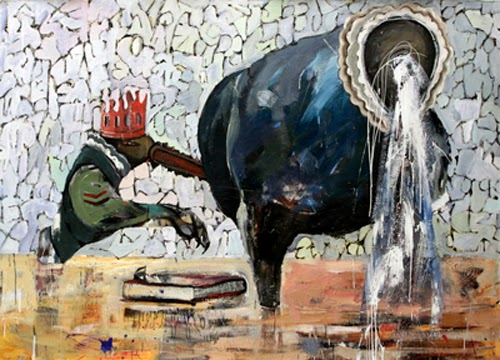
The Saw of Royalty*, 2008, 72 X 96ins, acrylics, oils, and enamels on canvas


Coronation Map**, 2008-2010, 53 x 49 ins, mixed media on canvas.


Eclipse, 2007, 68x47ins, acrylics, oils, and enamels on canvas.


Falcons and Teddy Bears, 2005, 47x68ins, acrylics, oils, and enamels on canvas.


Golden Boot, 2010, 48x32 ins, mixed media on canvas.


Hustler*, 2008, 72x96ins , acrylics, oils, and enamels on canvas.


Levitation*, 2008, 72x96ins, acrylics, oils, and enamels on canvas.


Libido, 2009, acrylics, oils, and enamels on canvas.


Libido Spit, 2006, 96x72ins, acrylics, oils, and enamels on canvas.


Minerals*, 2008-2013, 72x120ins, acrylics, oils, stickers, enamels


Mortality**, 2006, 38x65ins, , acrylics, oils, and enamels on canvas.


Study Of Figmentation I**, 2006, 42x68ins, , acrylics, oils, and enamels on canvas.


The Origins of Art | Côte d’Ivoire

Let us look at the life lived in Cote D'Ivoire and festivals that are performed every month..And so how does an artist reflect these wild colourful ideals to a passive European audience. An artist that is from the sun and this show of cultural behaviour through the performance artists, how can he become an international artist in his own right?

Images from Côte d’Ivoire including the stilt festival


Fig 1.


Fig 2.
Fig 4.
Fig 3.

 
Masks From Côte d’Ivoire from the Dan Tribe


If African Art starts anywhere it starts here.......


Monday, 27 October 2014

ERNEST DÜKÜ | Et Dieu Crea La Pintade


Ernest Duku | Et Dieu Crea La Pintade


And God Created the Guinea Fowl

Western ideology is foreign to most parts of Africa in terms of seeing. Art in Africa is participatory, it is like the traditional religion of Voodoo/Voodou, it is the ephemeral for all to enjoy naturally in order to gain a sense of belonging. The beauty of a leaf, a tree, feathers from a bird, a footprint of an elephant on red soil or the cheetah’s majestic coat. Art is everywhere but in the West they have a vulgar way of caging and monetizing almost everything; be it their zoos, their water, light and air, even their walks to their workstations comes at a price. Western art is useless to Africa. It is alien and destined for deportation in every way. What is claimed as valuable is nonsense to most. Images on canvases, usually with factory manufactured oils or acrylics from China are then framed and heralded as Masterpieces by the academic world in their overpriced, high-walled, stuffy and archaic Institutions to which they belong. The ideas are presented perfectly, neatly framed, so too are the minds of the viewers. To the majority in Africa, these images are not seen naturally and therefore serve no purpose as Art, for at no point is there a sense of inclusion. It is more dictatorial with an unhealthy sense of superiority, often blended with a self-righteous ‘I told you so’ attitude attached. Art in Africa is a far more collective affair, a glue for a united community rather than a status symbol or a blinkered state of mind. The sense of sharing knowledge and giving the baton over to others is where Art lives but this generosity is rarely seen in the Art World. we are at a turning point in the History of African Art and never in history has there ever been a more important time to address these vital issues. In the works of Ernest Duku, Africa has a chance to show it's true strength and power.

Early 20th Century Yoruba Divination Board
To begin to understand the concepts behind the art created from the artist, Ernest Duku, we must firstly learn about the source of where these ideas originate. In appreciating the artist's cultural background will lead inevitably, to a more comprehensive undestanding of the works. The visual narrative in Duku's work makes constant reference to his African upbringing and refers to the ancient practices, which remain pivotal to rural societies within Cote D'Ivoire. Although the artist, now lives in Paris, he reaps immense solace in his faith and sacred cognitive heritage, which makes his art authentically African. The days, months and years are mapped out through a series of rituals that poignantly speak to the people living within the villages of West Africa. These indigenous practises are oral rather than scriptural and are performed outside in order to worship the grandeur of nature. Triggering the ascend of the spirits with alcoholic libation they call upon the ancestors for reassurance and wisdom.  This practise is rudimentary to most West Africans as they place so much emphasis on the ancestors. This connection to the past yields a tremendous sense of belonging. The ancestors play a vital role in the personal and collective guidance to those, here on earth, and alleviates the crippling loneliness suffered by many in the developed world. Other major aspects include magic and the extensive knowledge of traditional herbal medicines. These factors are the necessary keys to unlock the heart of the artist's past and are fundamental in appreciating his unique works of Art. In deciphering these primitive nuances we are better equipped in finding our universal humanity. To those in West Africa the role of humanity is generally seen as one of harmonising nature with the supernatural via 'divination'; this phrase comes from the Latin divinare, "to foresee, to be inspired by gods", related to divinus, the divine. In rural Africa this divination comes in the shape of a vessel, which is used in the attempt to gain insight into puzzling social challenges by way of indigenous rituals. Diviners are closely connected to the earth and the spirits that surround us and once contact has been made are then presented with a series of events, signs and omens via the supernatural world. These clairvoyant visions or prophet dreams, which are bestowed on the witch-doctors can be ambiguous but always opportune for interpretations. This process is carried out under a systematic method by which to engineer issues that are often unexplainable; what appears to be disjointed or random facets of existence can then be mentally digested with clear insight on any given problem. These acts have formal or ritualistic elements attached and are the glue that binds the community together. Sadly, these practises are dismissed by the majority in the Western world who have been made sceptics, many of whom live without faith or a deeper understanding of the importance of mysticism.

Let us call upon the ancestors to show their force here with us on earth. We maybe many but we come from even greater stock and our full force has yet to be recognised. Far too often we are standing in the shadows, nervous we are not worthy of note but in reality we are what the world is aching for..bored of seeing the utter dribble shown in the name of Modern Art.

What and who are these Saints? These are our ancestors, our great noble past...good and bad.


Let us now focus on the artwork, Et Dieu Crea La Pintade | And God Created the Guinea Fowl and discuss it's makeup...The idea of art created with a frame is unnatural for Africa. To be contained in that framework makes no sense or nonsense to the majority and Ernest is well aware of these limited parameters..so he's taking his work out of the frame and making a whole new version of art in his own unique way..
.
Initially I thought the work was made up of polystyrene, a material used when learning how to swim and denotes that idea of travel.

That idea of water and immigration and overseas adventures...The idea of learning to float, learning to keep up with the sharks and swim with the fishes but in a good way..The idea of leaving the shallow-end and keeping afloat in the deep-end but the artist assures me that the material is his own invention. He tells me it is a mixture of paper, wood shavings and powder along with other secret materials. He blends them all together and creates a paste that is similar to the white plaster used on North African new builds. The paste is then shaped and left to harden in the sun and then once hardened Ernest then goes to work of shaping out his ideas around the mould with different coloured threds that binds the divination and holds the work together. The flashes of red in this piece denotes the sacrifice created and a Guinea Fowl is a very precious animal to give to the Gods...a prized bird indeed. The guinea fowl are a family of birds in the Galliformes order, although some authorities include the guinea fowl as a subfamily, Numidinae, of the family Phasianidae. So why the Guinea Fowl? The speckled hen...what is this bird? Where does it come from? The origins are West African and this spectatular bird is a symbol of safety in childbirth. The Guinea fowl is prized by the French…largely ignored by the British and is a bird of legend that has been used as food for thousands of years.


In the time of the Pharaohs, 2400 B.C. images of the bird were inscribed on the walls of temples and pyramids. The figure takes pride of place on the work and is the central motif and holds the work together as the major theme. Also we see the feet of the bird repeated in the artwork, which depicts luck of a fowl's foot; alongside these feet are different symbols, which are hyroglifics and Nubian signs of Ankh the symbol for eternal life and the staff beside it is to soul-catcher from Eastern and Northern Africa, so the artist pulls from the entire Continent to share his ideas within this work trying to weave a connection into a complex Continent, which is united in similar ideals of creativity, global conciousness and divinity.


Words by Joe Pollitt 2014


Thinking of Ms. Lauryn Hill and she's used a track from The SLITS. Perfect.